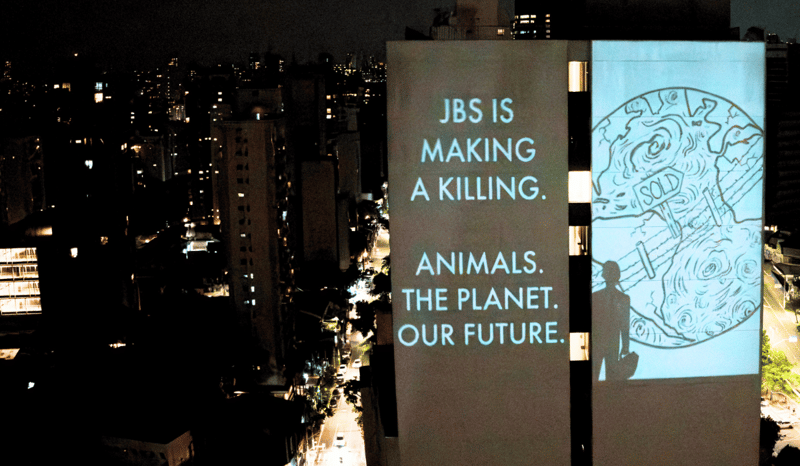
The World’s Biggest Meat Company Has a Cruelty Problem. We’re Trying to Stop It.
Blog
Behind every JBS product is a hidden cost: billions of animals confined in agonizing conditions, a planet under siege from industrial pollution and deforestation, workers and communities put at risk, and a company that has repeatedly misled the public about all of it. Here's what you need to know—and what we're doing about it.
JBS S.A. is a Brazilian multinational and the single largest meat processing company on Earth. Founded in Brazil and now operating in 20 countries with products sold in over 100, JBS earns roughly $77 billion in annual revenue—more than half of it inside the United States. Its brands include Pilgrim’s Pride, Swift, Moy Park, and Seara—names familiar to shoppers across every major supermarket chain in America and around the world.
The sheer scale of JBS’s operations is almost incomprehensible. The company has the capacity to slaughter more than 13 million chickens, 128,000 pigs, and 77,000 cows every single day.
JBS recently completed a long-sought listing on the New York Stock Exchange—even as World Animal Protection’s own research revealed the company may have avoided between $221 million and $442 million in taxes owed to the US, UK, Canada, Brazil, Australia, and Mexico.
Why Is World Animal Protection Targeting JBS?
World Animal Protection has made JBS a centerpiece of our global factory farming campaign for a simple reason: no single corporation is responsible for more animal suffering at greater scale. JBS is not just one bad actor among many—it is the engine that drives the worst excesses of industrial meat production worldwide.
We have been part of the Drop JBS Coalition, working alongside allies for years to disrupt JBS’s access to US capital markets and prevent the company from using investor money to further expand its cruel operations. In 2024 alone, we mobilized 20 Nigerian civil society organizations to oppose a government agreement with JBS that intends to entrench industrial-scale factory farming on another continent.
JBS has also demonstrated a pattern of making bold public commitments—on animal welfare, on climate, on deforestation—while its actual practices tell a very different story. Multiple investigations have connected JBS supply chains to illegal deforestation in the Amazon, even after public pledges to end such practices.
JBS has also been fined for US child labor violations, settled antitrust lawsuits worth hundreds of millions of dollars, and faced worker rights crises at its meatpacking plants. Holding JBS accountable means holding the entire industrial meat system accountable.
JBS’s Cruelty to Animals and the Planet
The harm caused by JBS is not incidental—it is structural. It flows from a business model that treats living, sentient beings as units of production and treats the natural world as an infinite resource to exploit.
Animal Cruelty
JBS kills more animals than any company in history, and the scale of suffering that drives it is almost impossible to comprehend. On JBS farms, piglets have their tails severed and teeth ground down without pain relief. Chickens are crammed into spaces smaller than a sheet of paper, bred to grow so fast their hearts and lungs cannot keep up—many collapse under their own weight before they ever reach slaughter. Mother pigs spend the majority of their lives locked in gestation crates so narrow they cannot turn around, lie down comfortably, or engage in a single natural behavior. Confined, in pain, and deprived of everything that makes life bearable, many develop the repetitive, compulsive behaviors that animal behaviorists recognize as signs of psychological breakdown.
Those who survive to slaughter arrive malnourished, injured, and terrified. Many are improperly stunned—and feel every second of what follows.
This is not the result of a few bad actors. It is the system working as designed. At Pilgrim’s Pride facilities, investigators documented workers throwing and kicking live birds. In 2018, footage from a Kentucky JBS supplier showed workers kicking and punching pigs, and mother sows locked in gestation crates the company had publicly pledged to phase out by 2016. JBS’s response in both cases was the same: express concern, suspend the supplier, and make no systemic change.
The cruelty is the business model.
Climate Catastrophe
JBS’s global pig and chicken production alone generates emissions equivalent to 14 million cars on the road every year—more than double the second-largest factory farming emitter.
JBS has been fined for sourcing cows from illegally cleared Amazon land, and investigations as recently as 2024 found the practice ongoing. Brazil’s environmental agency, Ibama, documented two JBS plants in Pará purchasing 59,000 cows from ranches on 507 square kilometers of embargoed forest. The consequences aren’t abstract: Brazil has experienced unprecedented flooding driven in part by the very deforestation JBS’s supply chain accelerates.
Half of Earth’s habitable land is already used for agriculture. Seventy-seven percent of that is devoted to animal agriculture. JBS is the engine driving that expansion, and every year it grows, a livable planet becomes less possible.
Yet JBS calls itself a climate leader. JBS promoted its “Net Zero by 2040” pledge in ads claiming, “Bacon, chicken wings, and steak with net zero emissions. It’s possible.” It wasn’t—and it isn’t. The company has no credible pathway or technology to make those claims a reality. The New York Attorney General sued JBS USA in 2024 for false advertising around its “Net Zero by 2040” pledge, ultimately reaching a $1.1 million settlement.
What We’re Doing to Stop JBS
The Annual General Meeting is the moment JBS and its shareholders celebrate profits, set dividends, and chart the company’s direction. It is also the moment to name what those profits cost. JBS causes massive environmental, ethical, and systemic risks onto animals, communities, and the planet. That deserves a spotlight, and today, it has one.
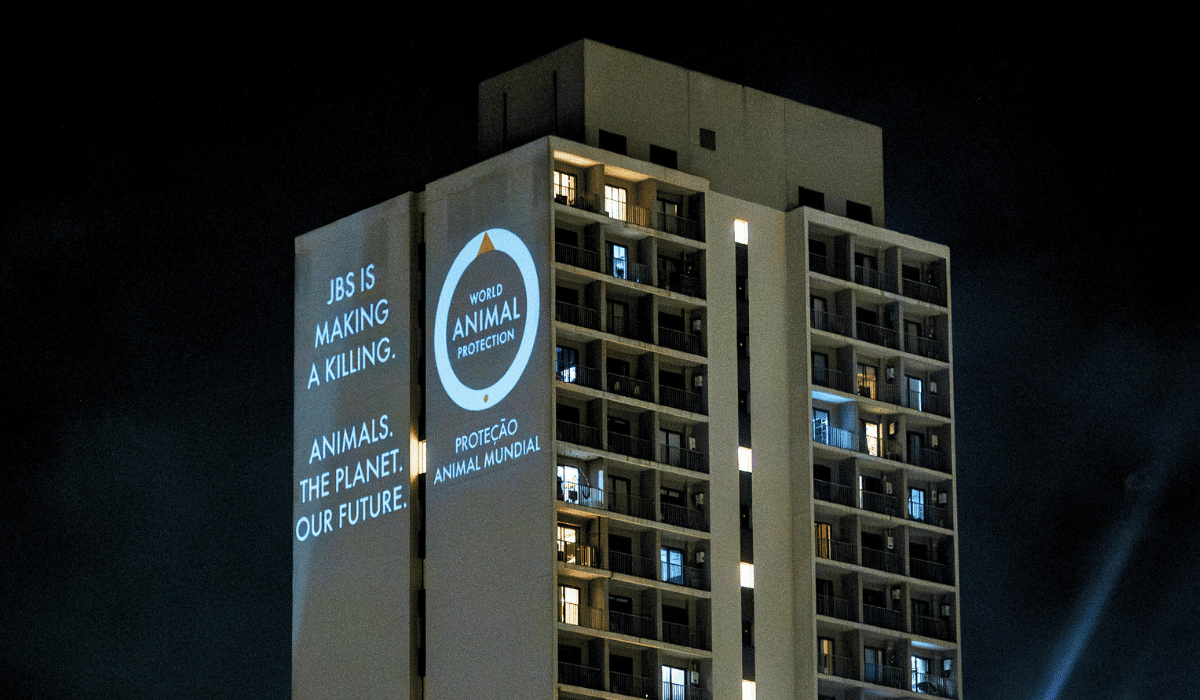
On the evening of April 29, World Animal Protection’s Brazil team projected bold, striking visuals onto prominent locations—designed to be seen, photographed, and shared around the world. The message is simple: JBS’s record of corruption, cruelty, tax avoidance, and greenwashing makes it a material reputational and financial risk. Investors deserve to know the full picture.
JBS Is Making a Killing. Help Us Stop It.
World Animal Protection is fighting to expose JBS’s true costs—to animals, to the planet, and to anyone who invests in its future. Every dollar you give funds investigations, campaigns, and the global pressure needed to hold JBS accountable. Please become a monthly donor today.