Bred to Entertain: Our New Report Covering Captive Elephants in Thailand
Blog
Our new research shows two-thirds of captive elephants in Thailand’s tourism industry still live in poor conditions, despite some welfare improvements.
In our latest report, Bred to Entertain–a New Assessment Capturing 15 Years of Thailand’s Elephant Industry, our International Wildlife Team assessed 236 tourism venues housing 2,849 elephants across Thailand between February 2024 and January 2025. Led by World Animal Protection elephant expert and wildlife veterinarian Dr. Jan Schmidt-Burbach, our team found that nearly two in three captive elephants are still living in poor conditions, despite some limited progress since the last assessment in 2019.
Using nine animal welfare criteria, the study found persistently low-welfare standards across venues, with results almost identical to those recorded in 2019.
“This demonstrates that the serious concerns about the welfare of elephants in tourism venues remain largely unchanged,” says Dr. Jan Schmidt-Burbach.
There is a slight decline in elephant riding
The research confirms a continued decline in elephant riding. In 2010, 92% of captive elephants were used for rides. By 2024, this had fallen to 43%.
“While impressive, this drop needs to be put into perspective as the overall number of captive elephants in tourism has increased by more than 70% in the same timeframe. So, the actual number of elephants used for rides has only decreased by 20%,” explains Dr. Jan Schmidt-Burbach.
Research finds chaining and restricted movement widespread
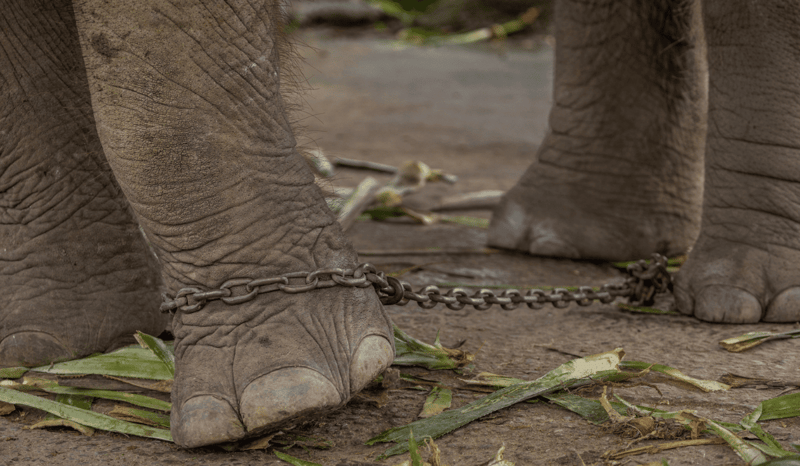
All 236 venues were visited in person by trained researchers, often without prior notice. More than half of all elephants were kept on short chains during the day, with limited opportunities for social interaction. Only a quarter could interact freely with other elephants while unchained, and many spent long periods standing on concrete in noisy environments.
Washing experiences mislead tourists
While riding and shows are declining, elephant washing and care experiences have increased. In 2024, more than half of all captive elephants were kept at venues offering washing or care-taking activities.
These venues often market themselves as sanctuaries or rescue centers, misleading tourists into believing these experiences are ethical. In reality, elephants are denied choice and compelled to interact with unfamiliar visitors.
Elephants do not need tourists’ help to be washed. In the wild, and in genuine sanctuaries, elephants are fully capable of keeping themselves clean.
Observation-only venues increasing
Encouragingly, observation-only elephant experiences with no direct human contact are increasing. In 2024, 7.3% of captive elephants were kept at venues offering observation-only experiences, compared with 4.6% in 2010.
“In many instances, venues offering purely observational experiences have received the highest welfare condition scores in our research, as they also adopted best practice elephant management routines. But just because a venue offers observational experiences, better welfare for the animals is not guaranteed,” says Dr. Jan Schmidt-Burbach.
How to help
Become a wildlife-friendly traveler by making sure you prioritize animal well-being. Viewing animals from a distance in the wild with responsible tour operators has the least impact on wildlife. Wildlife Heritage Areas provide designated protected areas that protect animals, the environment, and local communities through ethical tourism.
If choosing to see elephants at a venue or sanctuary, research authentic experiences and venues that provide great care for them. Read more in our Elephant Friendly Tourist Guide.