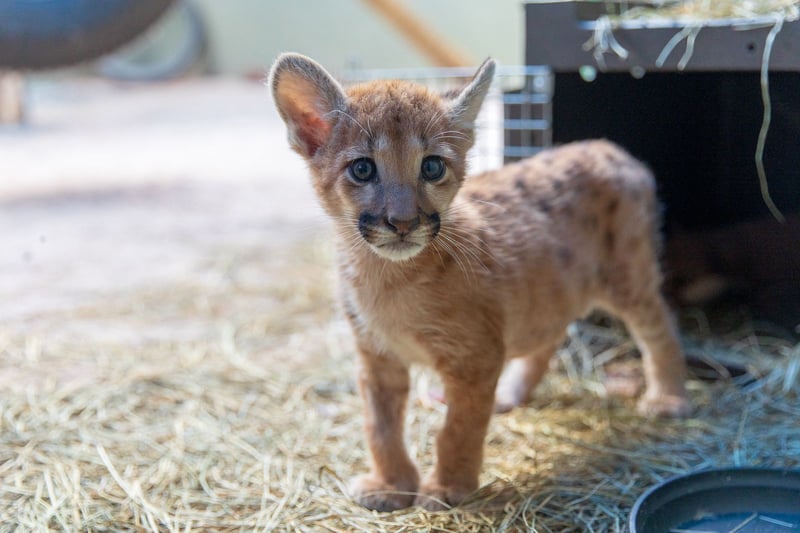
Thanks to you, pumas Alfa and Beta were rescued in rural Brazil and are now in rehabilitation to ensure they develop the natural behaviors of their species.
Just before Christmas, while many were shopping for gifts for loved ones, Alfa the puma’s day was far from festive. On December 22, 2023, this three-month-old puma cub was spotted wandering alone and frightened in the countryside of Iaciara, a municipality in Brazil’s northeastern state of Goiás. Weighing only 2.8 lbs and noticeably fragile, Alfa searched for her mother, who never returned.
Three months later, on March 8, 2024, a similar situation drew attention in Pires do Rio (also in rural Goiás). The appearance of another puma cub, roughly four months old and weighing 5 lbs, startled the local community. Named Beta, the young cub was also alone and was suffering from an eye injury. With support from the Suçuaranas no Quintal project, the agents from the Brazilian Institute of the Environment and Renewable Natural Resources (IBAMA) spent two weeks searching for her mother, without success.
The similarities between Alfa and Beta’s stories are no coincidence. These pumas live in the Cerrado biome and are just two of countless victims of the threats affecting local wildlife. Also known as cougars, mountain lions, and red tigers, pumas (Puma concolor) face pressure from extensive hunting. In livestock areas, they are often killed in retaliation for the loss of cows raised for beef.
In addition, agricultural expansion, urban development, and new road construction contribute to habitat fragmentation and declining feline populations due to roadkills, loss of natural prey, and habitat destruction. Alfa and Beta’s mothers most likely died or were driven away due to these conflicts.
Their tragic fates merged when both cubs were taken to the Federal District Wildlife Screening Center (CETAS-DF). Later, they were transferred to a specialized enclosure run by Instituto NEX, where the cubs have minimal human contact and benefit from an environmental enrichment program designed to develop their physical, sensory, feeding, and cognitive abilities.
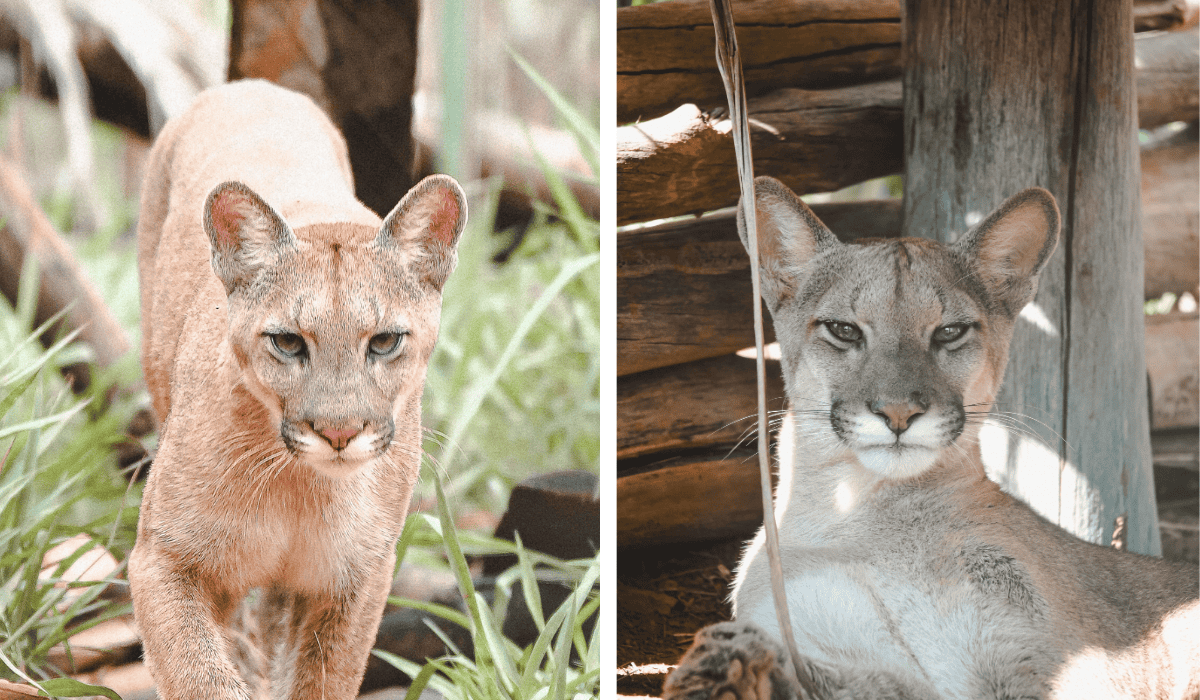
Pumas Alfa (left) and Beta (right). Credit: Caio Cavalcante
Today, at approximately 23 and 20 months old, respectively, Alfa and Beta are strong, healthy, and exhibit the behaviors expected of wild pumas: they are alert, know how to camouflage themselves, and can identify and hunt live prey.
These are promising signs that they may complete their rehabilitation journey and return to the wild. The next step requires moving them to a pre-release enclosure—this new facility is being built in the Brasília National Forest, where CETAS-DF is located. There, Alfa and Beta will have a larger area, with greater exposure to native vegetation and wildlife, allowing them to reach optimal conditioning in a more complex and natural environment. It is in this phase that specialists monitoring their progress will determine whether the cubs are ready for release.
World Animal Protection believes Alfa and Beta’s journey can have an even better ending—with their return to a free life. That is why we are supporting the construction of the pre-release enclosures through a Cooperation Agreement with IBAMA and mobilizing partners to make their reintroduction possible. Together, we can give Alfa and Beta a second chance at life in the wild—where they belong.
Join The Wild Side to help protect them and countless other animals.