The grades are in, and major US restaurant chains are still falling behind in their plant-based offerings.
Moving the Menu 2026 reevaluates the top 25 chain restaurants in the US across five cuisine categories, assessing their menu offerings, plant-based innovation, and commitments to reducing animal-based foods to reflect whether critical progress is happening within the sector.
Despite growing consumer demand and clear environmental and animal advocacy imperatives, the findings conclude that most chains continue to offer few plant-based by default options and maintain meat-heavy menus as the default. Overall, progress remains slow, and many chains show little to no movement toward meaningful plant-based menu integration.
Disappointing Scores Across the Board
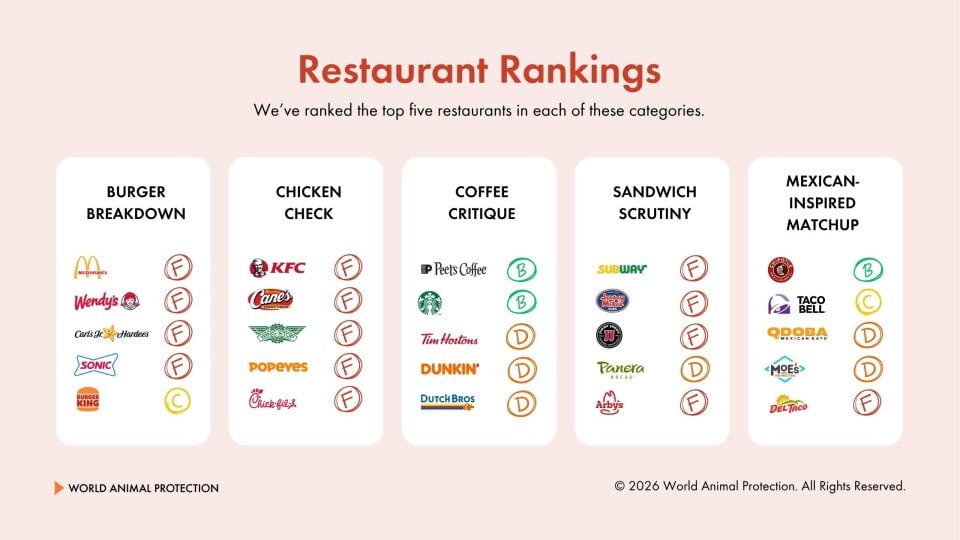
Most major restaurant chains have not expanded plant-based by default options or significantly improved their menus. Burger and chicken chains continue to largely center animal-based products, with only Burger King showing limited movement through Impossible items (though not by default). Coffee chains like Starbucks, Dunkin’, Dutch Bros, and Peet’s have eliminated plant-milk surcharges—a positive shift—but food menus remain overwhelmingly animal-based.
While Chipotle and Peet’s continue to offer strong plant-based options, very few chains have taken the step to make them the default, leaving animal products as the industry standard and reinforcing outdated ideas that plants should be secondary.
What’s Holding the Menu Back
The 2026 findings reveal a disconnect between industry trends and meaningful menu change. Restaurants increasingly highlight themes like high-protein offerings, menu innovation, and consumer choice, yet these trends have largely reinforced the dominance of animal-based ingredients rather than aligning with the change that’s actually needed: expanding plant-based foods.
Protein-focused marketing has become especially influential in shaping menus even since our last scorecard in 2024. Across fast-food chains, new launches frequently market animal-based “protein” ingredients as the defining feature of a meal. This framing overlooks the wide range of plant-based foods that can provide nutritious, satisfying options while reducing environmental impacts and helping to shift to a food system that does not rely on cruel factory farming.
But it’s not all bad news. Some smaller shifts show that change is possible. Notably, coffee chains are increasingly eliminating surcharges on non-dairy milk, demonstrating that restaurants can normalize plant-based choices when they choose to prioritize them.
The challenge ahead is clear: rather than treating plant-based foods as niche additions or limited-time experiments, restaurants must begin integrating plant-based foods and dishes as central menu offerings and part of their core business.
If progress remains stagnant, or worse, backtracks, the result will be continued reliance on environmentally destructive and inhumane factory farming, perpetuating climate harm, biodiversity loss, and preventable animal suffering.
Take Action Now
Moving the Menu 2026 is a wake-up call: the restaurant industry is not moving fast enough. Restaurants have the opportunity—and responsibility—to prioritize plant-based meals, make them the default option, and help shift our food system toward a kinder, healthier, and more sustainable future.
You can help amplify this change. McDonald’s is failing to meet the moment—tell the company to make plant-based options permanent and widely available across its US menu.