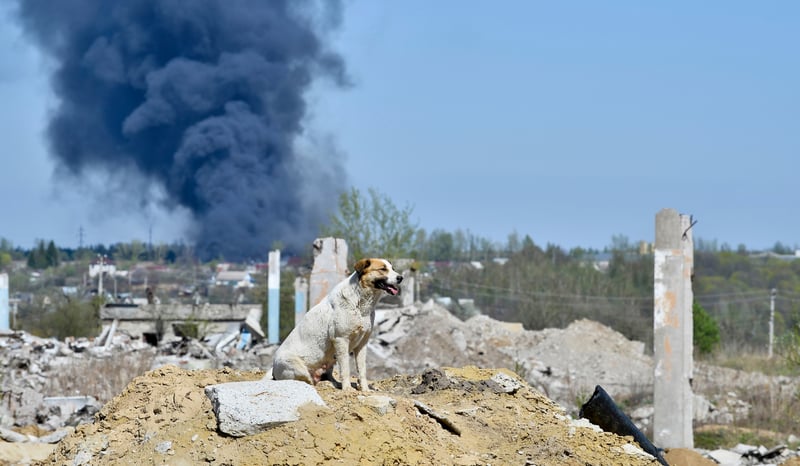
Discover how war impacts animals, from habitat destruction to noise pollution and deadly military activities.
When we think of war, we picture crumbling cities, displaced families, and shattered lives—and rightly so. But in addition to the human suffering, another story unfolds across bombed plains, scorched forests, and abandoned streets: the story of animals whose homes, health, and very existence are upended by human conflict.
From wild animals fleeing the thunder of shells to companion animals left behind, and even animals forced to serve alongside soldiers, war’s cruelty reaches far beyond the people caught in its path. Forests are burned, wetlands drained, oceans polluted, and ecosystems thrown into chaos. Noise from bombs and military sonar can disorient whales and birds, while landmines and chemical contamination turn once-safe landscapes deadly.
The devastation touches human lives, animal lives, and the environment alike. Families are uprooted, wildlife is pushed to the brink, and the natural world struggles to recover. Every bomb dropped, every forest burned, and every habitat destroyed is a stark reminder that the cost of conflict is universal—and unbearably high.
1. Wild Animals: Nature in Flight From Violence
Imagine a lush meadow or a bustling riverbank—now picture it echoing with the boom of artillery, the roar of warplanes, and the whine of mechanized vehicles. Bombs, missiles, and other weapons don’t just destroy buildings; they shred ecosystems. Explosive blasts release heavy metals and toxic residues into soil and waterways, poisoning habitats that birds, mammals, reptiles, and fish rely on for food, shelter, and breeding. In places like modern‑day Ukraine, ecological experts warn that ongoing warfare has endangered hundreds of plant and animal species and disrupted migration, breeding, and food chains across forests and wetlands. In Palestine, experts warn of severe and potentially irreversible environmental damage, including to wetlands, dunes, and coastal waters. In Sudan, fighting has damaged industrial sites, resulting in severely polluted air, water, and soil. The noise of combat—from jet engines to artillery barrages—can be as harmful as the physical destruction. Animals with sensitive hearing, such as owls and deer, may flee in panic, abandoning nests and migratory routes, or find themselves disoriented long after the fighting ends. Landmines and unexploded ordnance lie in wait, posing deadly threats not just to humans but to wildlife long after peace treaties are signed.
Even places once rich with wildlife can become hostile. In parts of Ukraine, normally teeming with thousands of species, war has caused animals to retreat, stray into dangerous urban spaces, or disappear altogether, illustrating how conflicts ripple through ecosystems in devastating ways.
Military conflict doesn’t just devastate the land it’s fought on—it reverberates underwater, too. Naval warfare often relies on powerful active sonar systems to detect submarines, but these intense sound waves can travel vast distances through the ocean, overwhelming whales’ highly sensitive hearing.
Species like the Cuvier’s beaked whale are especially vulnerable; exposure to mid-frequency active sonar has been linked to mass strandings, internal injuries, disorientation, and panic dives that can cause decompression sickness. For animals who depend on sound to navigate, communicate, find food, and care for their young, sonar can effectively blind and deafen them in their own habitat. In times of war, the ocean becomes louder and more chaotic—and whales pay the price for a conflict that isn’t theirs.
2. Companion Animals: Forgotten Faces Amid Ruins
For many, companion animals are family, but when war strikes suddenly, people are forced to leave their homes with little time or means to take food, water, or even crates for their dogs, cats, or other small animals. The result is heartbreaking: companion animals left behind to fend for themselves amidst rubble and gunfire. In Ukraine alone, shelters discovered hundreds of malnourished or dead companion animals after bombings cut off access to food and care. Currently in Dubai, companion animals are being left in the streets while their humans flee for safety, leaving shelters in the area overwhelmed and overflowing in a war zone.
Some stories, however, remind us of compassion amid chaos. Volunteers and soldiers have risked their lives to rescue abandoned dogs and cats, forming emotional bonds and giving comfort to displaced families and stressed war‑weary children. Across cities like Kyiv and Lyman, companion animals like Zhuzha, Latka, and Donatello symbolize resilience and hope, even as they adapt to life after trauma.
In other haunting cases, companion animals suffer deep psychological wounds from loss and fear. The story of Conor, a parrot in eastern Ukraine, reflects profound emotional trauma—the bird showed signs of depression after losing his caretaker, a reminder that animals, too, feel loss and stress just as we do.
3. Animals Exploited for Food: Lost Livelihoods and Lingering Tragedies
Hens, cows, goats, and other animals exploited for food are sentient beings, often born and raised in the same fields for generations. Yet war tears them from their routines and care just as surely as it does humans. Bombing and artillery smart destruction often obliterate barns, grazing fields, and water supplies. With supply lines severed, feeding and watering these animals becomes nearly impossible.
In the Gulf War of the early 1990s, more than 80% of animals exploited for food in some regions died, including hundreds of thousands of sheep and cows, and zoos were devastated—with the Kuwait International Zoo losing nearly all of its animals after deliberate oil spills and firestorm chaos. More recently, animals starved to death in zoos in Gaza and Sudan.
Millions of cows, pigs, and birds are difficult or impossible to transport during evacuations, leaving them vulnerable to starvation, injury, or death in war zones.
4. Animals in War: Service, Sacrifice, and Exploitation
For thousands of years, animals have been dragged into human conflicts—not merely as victims, but as unwilling participants. Long before tanks and drones, horses, mules, and donkeys carried soldiers and supplies for armies. In World War I alone, millions of animals served in transport, cavalry, and communication roles—and millions died in the process.
Dogs have been trained as messengers, guards, trackers, and detectors of explosives throughout many wars. While their intelligence and loyalty have saved lives, their service too often ended in injury or death. Even more unusual uses—from pigeons carrying crucial battle messages to dolphins trained for naval operations—remind us how far humans have pushed animals into the machinery of war.
Yet behind every example of service is the quiet cost paid by the animals themselves—lives interrupted, bodies harmed, instincts overridden by commands and harm.
Compassion Beyond Borders
From the bomb‑scarred grasslands that once echoed with birdsong to the shattered streets where frightened companion animals cower, war’s impact on animals and the environment should move us deeply. These are lives with their own stories, attachments, and sufferings—not merely collateral damage.
Recognizing their plight doesn’t detract from human suffering; it deepens our understanding of war’s full toll and strengthens our resolve to protect not only people but the entire tapestry of life that makes our world whole.
Donate to World Animal Protection today and help protect animals wherever and whenever they need us most urgently. We use your donation where it can do the most good and goes wherever the need for animal protection is greatest.