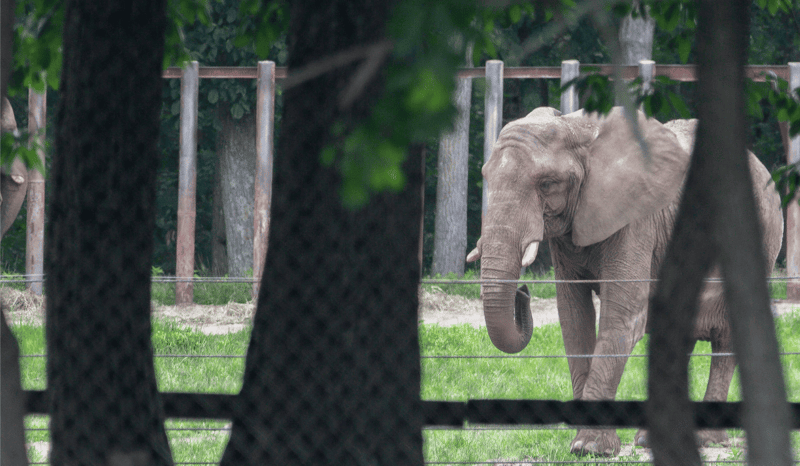
We know you have questions about Joyce. We have answers.
Since World Animal Protection launched our campaign to free Joyce, an African elephant held at Six Flags Great Adventure's Wild Safari in Jackson, New Jersey, thousands of people have joined us. But some have pushed back. Many of those comments come from people who have visited Six Flags for decades, worked there, or simply feel real affection for the elephants.
That affection matters. It's the same feeling that drives this campaign. But affection and accuracy are different things, and several claims keep coming up that don't hold up against the facts of Joyce's life or the science of what elephants need. Here are the most common ones.
Myth 1: "Joyce has been at Six Flags since she was a baby. It's the only home she knows."
Joyce wasn't born at Six Flags. She was born in the wild in Zimbabwe. In the 1980s, most of her family was killed in a government operation, and she was shipped to the United States as an orphaned calf, one of 63 young elephants taken from Zimbabwe at that time.
What followed was decades of being passed around: circuses, zoos, and other captive attractions. She arrived at Six Flags in 2010. That's 16 years at Six Flags so far, a fraction of her life, not all of it.
And even for an elephant who truly had known only one place, familiarity is not the same as suitability. Staying somewhere for a long time doesn't make it the right place to stay. Elephants who have spent decades in captivity adjust to sanctuary life again and again, and many show behaviors in sanctuary that they never had the room or the choice to express before.
Myth 2: "She looks healthy and doesn't seem stressed."
A glance from a safari vehicle is not a health assessment. Elephants are large, stoic animals, and the signs of chronic stress in captivity are often subtle to an untrained eye: repetitive swaying, head-bobbing, pacing, and other stereotypic behaviors that don't occur in the wild. The most serious harms, like foot disease and arthritis from standing on hard, unvarying ground in a small space, build slowly over years. They're among the leading reasons captive elephants are euthanized. We’ve asked the park’s leadership several times to allow an independent veterinarian to assess Joyce’s health, a request that has gone ignored.
Jan Schmidt-Burbach, World Animal Protection’s Director of Wildlife Research and Veterinary Expertise, visited Six Flags specifically to evaluate the elephants' environment, which he fears is woefully inadequate to meet elephants’ needs. We've also filed a complaint with the USDA over the lack of adequate shade for the elephants, including Joyce. An elephant standing quietly may convey low stress to an untrained eye, but the realities of the enclosure and lack of enrichment provided suggest otherwise.
Myth 3: "Moving her to a sanctuary would stress her out."
Relocation is a short-term challenge. Lifelong captivity is unsuitable.
Moving elephants is something experienced sanctuaries and veterinarians do carefully and successfully. Mundi, who came from Zimbabwe in the same group of orphaned calves as Joyce, flew to Elephant Refuge North America in Georgia in May 2023, at 41 years old. Edie was moved to The Elephant Sanctuary in Tennessee that same year. In 2024, Osh's zoo announced it would send him to sanctuary and close its elephant exhibit for good. Older elephants make this journey, and they settle in.
Six Flags has said Joyce is part of a bonded pair and that the relationship is critical to her well-being. We agree that her bonds matter. That's exactly why our campaign calls for sanctuary placements for all of the elephants at the Wild Safari, not just Joyce. Sanctuaries move companions together precisely so those relationships can continue, in an environment that finally fits them.
Myth 4: "The safari is hundreds of acres. They have more space than any zoo."
The Wild Safari covers more than 350 acres. Joyce does not.
That acreage is the whole drive-through attraction, divided among many species, roads, and vehicle routes. Aerial drone imagery we obtained shows Joyce's enclosure is roughly 1 acre. For an animal who would naturally walk as many as 40 miles a day, foraging and exploring as she goes, that's a severe restriction. For comparison, Elephant Refuge North America covers about 850 acres, the vast majority available to the elephants.
Heated barns and a pond are a shelter and a water source. They're not a habitat. And "better than another zoo" is a low bar. We don't think zoos are adequate for elephants either, which is why we've celebrated every zoo that has closed its elephant exhibit and sent its elephants to sanctuary.
Myth 5: "They're fed, they have great vets, and the staff love them."
We don't doubt that the people who look after Joyce care about her. This campaign is not an attack on them. Our concern is the environment Six Flags provides, not the individuals working inside it.
But food and veterinary care are the minimum, not the measure of a good life. Elephants need space to roam, varied terrain underfoot, choices about where to go and who to spend time with, and relief from constant noise and disruption. At Six Flags, Joyce lives beside roller coasters and a steady stream of safari trucks. The best veterinarians in the world can treat foot disease, but they can't add acreage or quiet to an amusement park. Many of the health problems captive elephants face are caused by the conditions they live in.
Sanctuaries offer excellent veterinary care, too. The difference is that they pair it with the space, conditions, and agency elephants actually need.
Myth 6: "Seeing elephants helps kids grow up to love animals."
It's worth asking what children actually learn when they watch an elephant in a small pen next to a roller coaster. Most likely, that wild animals exist for our entertainment and that confinement is normal.
Joyce isn't an ambassador for her species. She's an individual, with her own history and needs. Kids can build a real love for elephants through documentaries, books, live sanctuary cameras that show elephants roaming freely, and learning about the threats wild elephants face. That's a lesson rooted in respect, not spectacle.
And one more: "Shouldn't you focus on animals who need help more?"
We work on a wide range of issues, including animals exploited in the global wildlife trade and animals harmed in our food systems. Caring about one doesn't take away from another.
Joyce's own story shows how connected these issues are. Her life in captivity began with the killing of her family in the wild. Helping her now is part of the same work.
What we're asking Six Flags to do
Three sanctuaries in the United States could give Joyce the care and space she needs: Elephant Refuge North America in Georgia, PAWS Wildlife Sanctuary in California, and The Elephant Sanctuary in Tennessee. We're calling on Six Flags to:
- Work with one of these sanctuaries to release Joyce to their care
- Identify sanctuary placements for the other elephants at the Wild Safari and set timelines for their relocation
- Close the elephant enclosure and commit to never acquiring or breeding elephants again
Joyce has spent more than four decades being moved from one place built for people to another. She deserves to spend the rest of her life somewhere built for her.
Take Action for Joyce
You can help turn up the pressure on Six Flags right now. Visit FreeJoyce.org to urge Six Flags to retire Joyce and the other elephants to a reputable sanctuary where shade, space, and a better life are the baseline, not the exception.