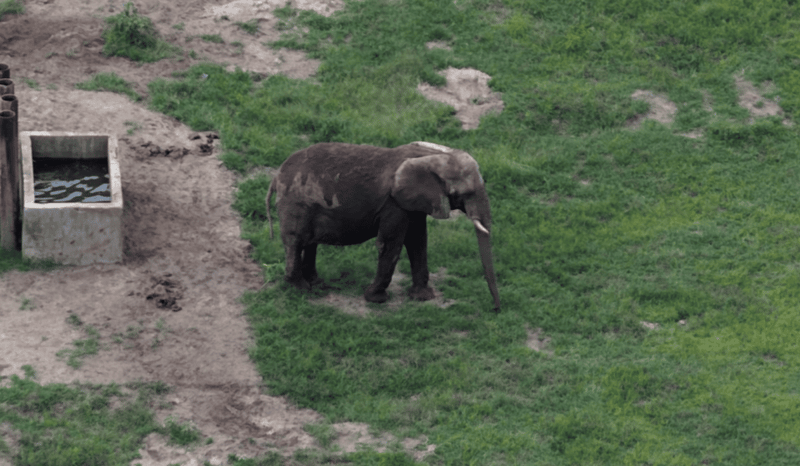
Explore what accredited elephant sanctuaries provide—and why Joyce, currently at Six Flags, deserves a chance for a better life.
When people learn that World Animal Protection is calling on Six Flags to release Joyce, one question comes up almost immediately: if not Six Flags, then where?
It's a fair question, and the answer matters. Joyce doesn't need yet another exhibit attraction—a wildlife sanctuary could give her a healthier, happier life. We want Joyce to live somewhere that offers her space to move, the ability to make her own choices, and doesn’t put her on display for the amusement of paying customers.
Mundi Shows Sanctuary Can Be Liberating
Joyce's story didn't begin at Six Flags. She was one of dozens of baby elephants orphaned in the 1980s after a government culling operation in Zimbabwe killed their families, then flown to the US and dispersed to zoos, circuses, and entertainment venues. Mundi was one of those same orphaned calves—put through the same wrenching displacement, and for decades kept alone in a small enclosure at a zoo in Puerto Rico.
In May 2023, after the zoo lost its license and closed, and with support from World Animal Protection US, Mundi was given a new home at Elephant Refuge North America (ERNA) in Attapulgus, Georgia—an 850-acre refuge of rolling hills, pastures, forests, and spring-fed lakes where elephants can stay outdoors nearly year-round. Within days of arriving, Mundi was released into the full habitat with fellow residents Bo and Tarra, and the three have become a tight-knit group. A year later, sanctuary founder Carol Buckley described Mundi as having made the transition to a life of autonomy, physical freedom, and family seamlessly.
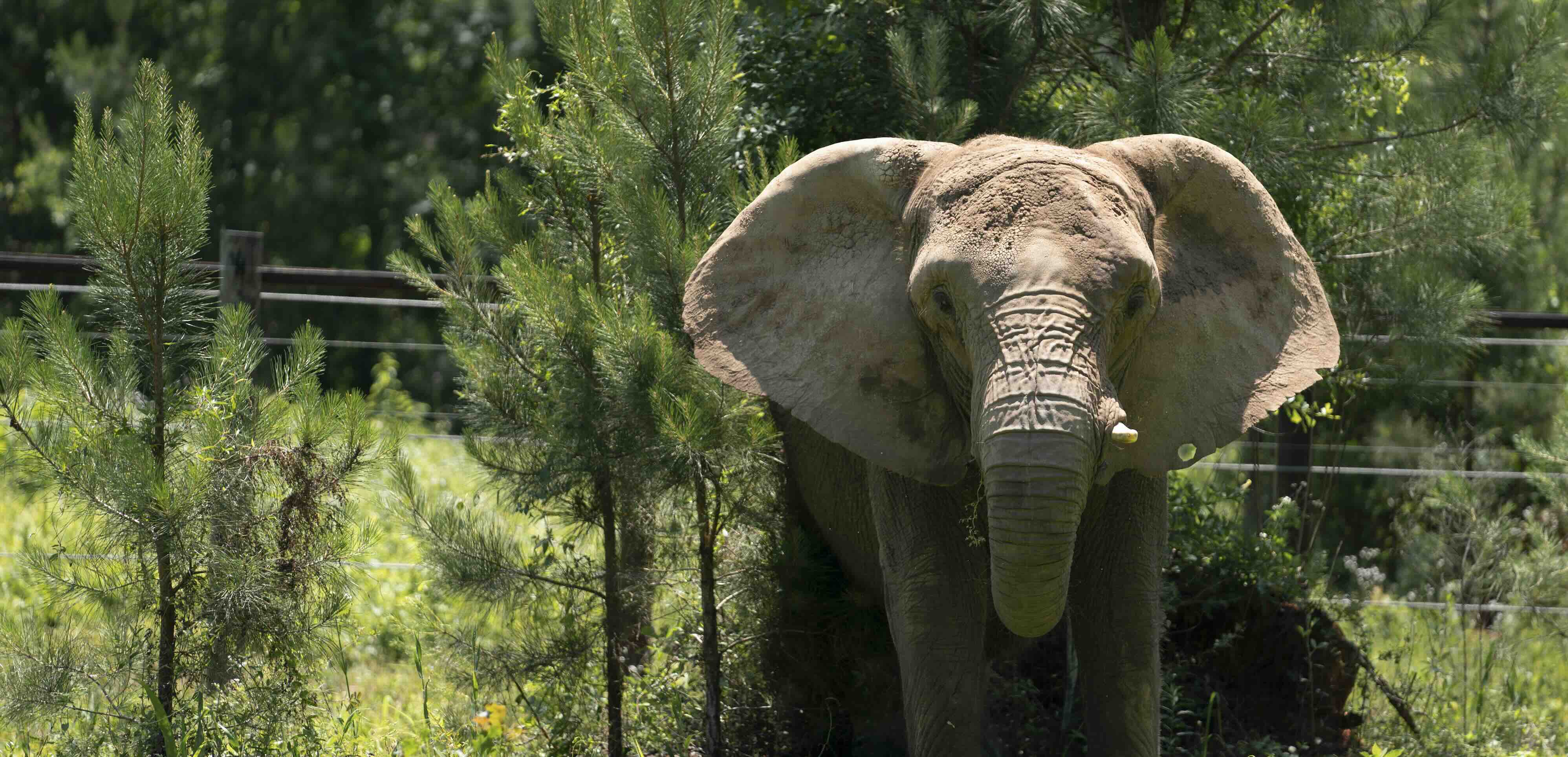
Mundi in her new home at ERNA.
At ERNA, a member of Joyce's own original herd is already living the life that’s possible for her.
What Sanctuary Actually Provides
Accredited elephant sanctuaries exist for one reason: to give captive elephants an opportunity to experience what has been denied to them. That means hundreds or thousands of acres to roam rather than a fenced enclosure. It means natural terrain—forests, pastures, lakes, mud wallows—instead of concrete and dirt. It means the ability to choose: where to go, who to be near, when to rest, when to seek shade or water. And it means real herd relationships, built on the elephants' own terms, rather than a group composed for the convenience of an exhibit.
That standard is what ERNA offers Mundi today, and it's the same standard maintained at other leading sanctuaries in the US that could be options for Joyce. The Elephant Sanctuary in Tennessee operates on 2,700 acres and is the nation's largest natural-habitat refuge developed specifically for elephants retired from performance and exhibition. It is currently home to more than a dozen elephants, including African elephants, with access to expanding explorable habitat and the opportunity for companionship, autonomy of choice, and space to move and explore. Performing Animal Welfare Society's ARK 2000 sanctuary in San Andreas, California, spans 2,300 acres and provides large, naturalistic habitats built around elephants' actual social needs, and has taken in elephants from zoos before, including three African elephants who arrived from the Toronto Zoo to share habitat with the sanctuary's resident African elephants.
Both The Elephant Sanctuary and Performing Animal Welfare Society are verified by the Global Federation of Animal Sanctuaries, the only organization that confirms a facility meets rigorous, peer-reviewed standards for legitimate care—not just a rebrand of the same captivity model. And unlike zoos, safari parks, or amusement parks, none of them exhibit their elephants to paying crowds. Their only obligation is to the animals themselves.
That's the standard we're asking Six Flags to meet for Joyce.
Why "Somewhere Else" Isn't Automatically Good Enough
It would be easy for Six Flags to quietly transfer Joyce to another zoo, safari park, or traveling exhibit and call the matter resolved. That would be a mistake, and we want to be clear about why.
The problem was never just this enclosure. Joyce's well-being isn't compromised only by a lack of shade—it's compromised by confinement itself. No zoo exhibit, however updated, replicates the space-dependent, cognitively engaging life elephants need. A transfer to another accredited zoo would still mean a fraction of the space, a human-curated social group, and a life built around public viewing hours rather than Joyce's own needs.
Entertainment venues share the same incentive structure. Any facility whose business model depends on public attendance faces pressure to prioritize visitor experience over what's best for the animal. A sanctuary has no such conflict—its only obligation is to the animals in its care.
Sanctuary means the end of the cycle. A sanctuary is a forever home. Once Joyce arrives, she's not going anywhere else. She gets to just be an elephant, for the rest of her life—potentially alongside a herd-mate who's already waiting.
Take Action for Joyce
Six Flags has a choice to make: keep Joyce in an enclosure that's already drawn a federal complaint, or do right by her and commit to an accredited sanctuary placement.
Visit FreeJoyce.org and urge Six Flags to send Joyce to sanctuary—not another exhibit, not another zoo, but a real, forever home.