The beef industry’s answer to rising costs? More confinement, more suffering, and greater public health risks.
In a recent article from Beef Magazine, industry voices discussed the growing shift toward more indoor confinement-style production for cows— a move that mirrors the factory farming systems long criticized in the poultry and pork industries.
For years, the beef industry has marketed its farming practices with imagery of open pastures and grazing animals. It’s already a false picture, given that the majority of cows exploited for beef in the US will spend at least part of their lives confined to an intensive feedlot.
This latest push toward even greater confinement reveals an uncomfortable reality: industrial animal agriculture is continuing to intensify, and cows are increasingly being pulled into the same high-density systems that have caused immense suffering for chickens and pigs.
And even the industry itself acknowledges these systems come with health concerns.
That should alarm all of us.
Confinement Is Expanding—Animals Will Pay the Price
Confinement systems are designed around efficiency and production, not animal well-being.
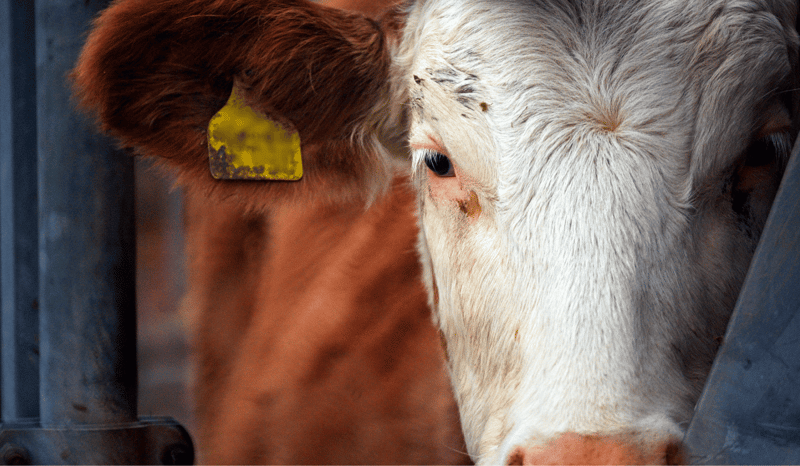
Instead of roaming and grazing naturally, cows in confinement barns can spend much of their lives crowded into enclosed environments with limited ability to engage in natural behaviors. These systems prioritize maximizing output while minimizing costs, reducing living beings to units of production.
The industry’s growing interest in locking cows in confinement barns reflects a deeper issue: when industrial animal agriculture faces economic pressure, companies often view increasing intensification as a cost-effective solution without considering the broader harms.
Rising prices should not become an excuse for expanding cruelty and increasing risk.
Rather than questioning our fragile food system’s heavy dependence on intensive animal agriculture, the industry is doubling down on confinement—despite the ethical and public health ramifications that come with it.
The Industry Admits There Are Health Concerns
What is especially striking about this shift is that concerns about confinement are not limited to advocates or public health experts—they are also acknowledged within the industry itself.
The Beef Magazine article notes that confinement systems require major changes in management and raise concerns around animal health and disease prevention. Concentrating large numbers of animals in enclosed environments increases stress and creates conditions where illness can spread more easily.
These risks are not theoretical. Public health experts have long warned that crowded animal agriculture systems can accelerate the spread and mutation of disease. Bovine tuberculosis, for example, is believed to have originated in cows before crossing into humans, underscoring the long-standing connection between animal production systems and human health.
When animals are packed into intensive systems, disease prevention often relies heavily on interventions like antibiotics and strict management controls rather than addressing the root problem: overcrowding and confinement itself.
A Warning Sign for the Future of Food
This move toward increased confinement is a clear signal of where industrial animal agriculture is heading—and it’s not a direction we can accept. As economic pressure builds, the industry’s default response is to intensify production systems, not rethink them, even when that means more animals living in crowded, restrictive conditions and greater costs to society.
We cannot allow intensive barn confinement to become the next normalized standard for animals exploited for beef.
Instead of expanding systems that confine more cows to meet demand, this moment calls for a fundamental shift toward plant-forward food systems that reduce reliance on industrial animal agriculture altogether. Every step toward more plant-based eating reduces pressure on these systems and lessens the number of animals subjected to confinement. Join our Plant Powered Changemakers network for resources, recipes, and support on your journey to more plant-based eating.