A new study finds more than 107,000 species, including 47,000 animal species, are bought and sold worldwide.
For years, the working estimate held that about 50,000 species were caught up in the global wildlife trade. That number was off by more than half.
A study published in Science Advances, led by the University of Melbourne, counts at least 107,356 wild animal, plant and fungus species in trade. More than 47,000 of them are animals. The researchers say even that figure is low, because most countries don't systematically track what is taken from the wild or sold across their borders.
Behind each of those 47,000 species are individual animals: pulled from forests, reefs and wetlands, packed into crates and sold as pets, ornaments, skins, and ingredients.
What the Study Found
The researchers combined data from conservation agencies, fisheries, the timber industry, the pet trade, and traditional medicine. What emerged is a trade far larger and more varied than the headlines about ivory and pangolin scales suggest.
- 107,356 species in trade, more than double the previous estimate of roughly 50,000 from the Intergovernmental Science-Policy Platform on Biodiversity and Ecosystem Services (IPBES).
- More than 47,000 animal species, from reptiles and amphibians to fish and birds.
- Butterflies alone outnumber IPBES's earlier estimate for every traded land invertebrate combined.
- Most of the trade is legal. Legal trade is worth roughly ten times the illegal trade, which researchers put at $28.4 to $39.5 billion a year.
- Wild populations pay the price. Where data exist, traded species' populations are on average 50 to 60 percent smaller than those of species left alone.
The fastest-growing corners of the trade are the least visible. Online sales of wild pets and “decorative” animals have exploded, and current monitoring systems barely register them.
Legal Doesn't Mean Humane, or Safe
The wildlife trade we often hear about is the criminal kind. The trade that's actually happening is mostly sanctioned by law. That means enormous suffering is fully permitted.
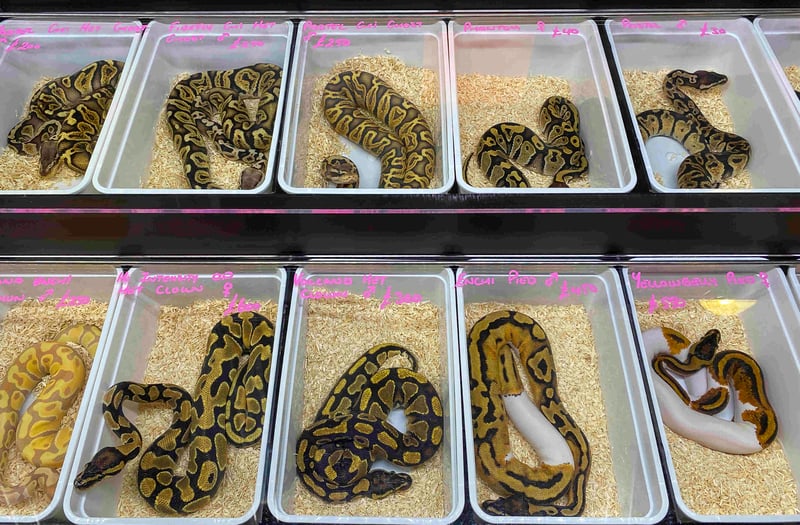
Wild animals are captured, confined, transported, and sold. Many die before they ever reach a buyer, and those that survive often end up in homes that can't come close to meeting their needs. A ball python, a parrot, or a poison dart frog is a wild animal, regardless of whether they’re in captivity or not.
The trade also puts people at risk. Packing stressed animals of many species together over thousands of miles creates ideal conditions for diseases to jump from animals to humans.
The rules meant to contain all of this were never built for a trade this size:
- CITES, the main international treaty, regulates trade in about 40,000 species, mostly ones already in trouble. Listing a new species can take years. By then, Hughes warns, a species can be virtually gone from the wild.
- The global biodiversity target on wildlife trade measures progress using fish stock data alone, covering at most three percent of traded species.
- Loopholes let wild-caught animals, including sought-after pets, be laundered into legality.
The US is one of the few countries that records wildlife imports species by species. That data alone documents trade in more than 21,000 animal species since 2000. Americans are not bystanders to this trade.
Captive-Bred Doesn't Mean Cruelty-Free
The pet industry sells "captive-bred" as the ethical choice. It isn't. Breeding wild animals for sale swaps one form of cruelty for another, and it keeps wild capture going.
An estimated 5.5 billion wild animals are bred every year for profit, including for the pet trade. On these farms or in these mills, animals suffer malnourishment, disease, injuries, and stress-induced behaviors. There is little to no evidence that captive breeding eases pressure on wild populations.
The US has its own version: bird mills. These are factory farms for parrots. Hundreds of thousands of parrots are bred in mills and shipped to pet stores across the country every year. World Animal Protection’s 2026 undercover investigation of four USDA-licensed bird mills in Oklahoma and Texas found:
- Thousands of budgies crammed into tiny, feces-coated cages in small barns
- Dead baby parrots in cages and a garbage can overflowing with dead birds
- An owner who admitted to suffocating birds he couldn't sell in a plastic bag, and who later admitted to killing birds with car exhaust
- A USDA citation for a barn with a heat index of 110.7°F, where an inspector found multiple dead birds
- Cockatoos and African grey parrots plucking out their own feathers, a sign of psychological distress
Every one of these facilities was licensed by the federal government. This is the legal trade working exactly as designed.
Captive breeding also feeds the capture of wild animals. Breeders turn to the wild for new breeding stock, and the "captive-bred" label gives traffickers cover. Wild-caught parrots, and even parrot eggs taken from nests, have been falsely declared as captive-bred to slip past trade rules. Captive-bred parrots now lead the international wildlife trade, and the world's largest supplier of African greys built its industry on imported wild-caught birds.
We Can't Count Our Way Out of This
The researchers call for coordinated, transparent tracking of the wildlife trade. Better data matters, but this study is the clearest evidence yet that regulating the trade of one species, one permit, and one shipment at a time cannot work.
Regulators were already overwhelmed when the trade was thought to involve 50,000 species. It involves more than twice that. New species are described, discovered by dealers, and stripped from their habitats faster than any listing process can respond.
The answer is ending the commercial sale of wild animals and protecting their natural habitats.
Wild animals belong in the wild. They are not pets, props, or products. A ban on selling them protects individual animals from capture and confinement, protects wild populations from collapse, and protects all of us from the next disease that crosses over from a crowded crate.
Take Action: Support a Ban on Selling Wild Animals
We know how big this trade is now. One of the most direct ways to shrink it is to stop selling wild animals in pet stores, city by city.
In New York City: Intro 912, introduced by Council Member Harvey Epstein, would ban the sale of birds in NYC pet stores and shut down the mill-to-pet-store pipeline. Tell your Council Member to support it.
Everywhere: Cities from Cambridge, Massachusetts, to West Hollywood, California, have already banned the sale of wild animals in pet stores. Yours can be next. Help end animal sales in your community.