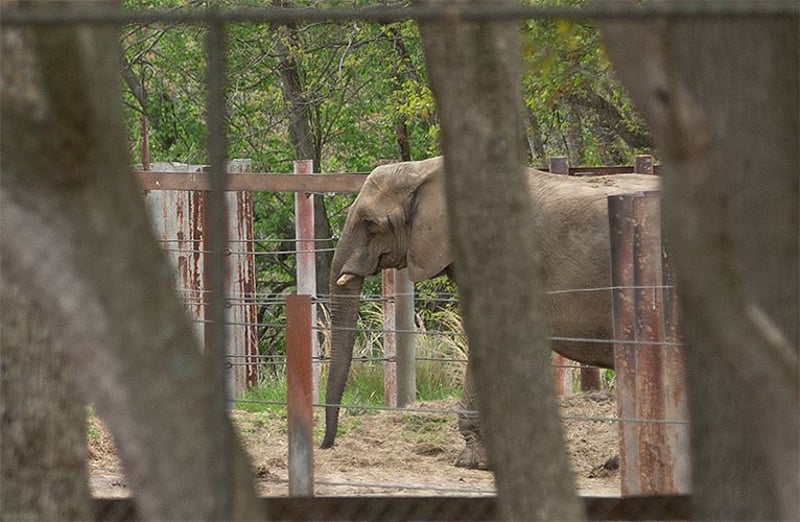
Six Flags Great Adventure is winding down another season. For the people who visit, that means the fun is over until spring. For Joyce, the hardest part of the year is likely just beginning.
Every fall, Six Flags Great Adventure goes through the same ritual. The Halloween crowds thin out, the coasters stop running, and the safari trucks park for the season. Families head home with photos of the elephants they saw from an open-air truck.
What they don't see is what happens next.
Joyce, an African elephant who has been held at the park's Wild Safari since 2010, is about to face her 17th winter there. And for an elephant in New Jersey, winter means one thing: going inside and staying there.
Into the barn
African elephants evolved for warm climates. They don’t tolerate long stretches of cold well, and New Jersey winters bring months of brutally freezing temperatures. So when the weather turns, Joyce is moved into a small barn next to her outdoor enclosure, where she will spend roughly four months.
Joyce’s outdoor enclosure is already tiny. Aerial imagery we obtained shows it measures about 1 acre, smaller than a football field, with bare ground and little to explore. In winter, that space disappears as Joyce's world shrinks to the inside of a building.
What months indoors do to an elephant's body
In the wild, African elephants range over enormous areas and can walk as many as 40 miles in a day, foraging and exploring as they go. That constant movement isn't a luxury. It's how their bodies stay healthy.
Confinement takes that away. Standing for long periods on hard, unvarying surfaces is closely linked to foot disease and arthritis, two of the most serious and common health problems in captive elephants and among the leading reasons they are euthanized. Less movement also means stiffer joints and weaker muscles, problems that only get harder to manage as an elephant ages.
Joyce is no longer young. She has been in captivity since she was a calf in the 1980s. Every winter spent mostly indoors adds to the strain on a body that was never built for this.
And what they do to her mind
Elephants are intelligent, curious, and emotionally complex. They need things to do, places to go, and choices to make. A barn, however clean or heated, offers very little of any of that.
When elephants are deprived of space and stimulation, many develop stereotypic behaviors: repetitive swaying, head-bobbing, or pacing that serves no purpose and doesn't occur in the wild. These behaviors are widely recognized as signs that an animal's needs aren't being met. Enrichment items and scattered food can help pass the time, but they can't replace miles of ground to cover and the freedom to decide where to go next.
The part of her life no one sees
The Six Flags Wild Safari is designed to be seen from a moving vehicle for a few minutes at a time, during the warm months. That's the version of Joyce most people know: an elephant standing in the sun as a truck rolls by.
But the off-season is a huge share of Joyce's year, and it happens out of public view. No visitors drive past. No one posts photos. The roughly four months she spends in the barn don't show up in anyone's memories of a summer day at Great Adventure.
That's exactly why it matters to talk about it. When people say Joyce looks fine to them, they're describing a few minutes on a summer afternoon. They aren't describing February.
What winter looks like in a sanctuary
Three sanctuaries in the United States can care for Joyce: Elephant Refuge North America in Georgia, PAWS Wildlife Sanctuary in California, and The Elephant Sanctuary in Tennessee. Each sits in a far milder climate than central New Jersey, which means far more days each year when elephants can be outside.
In a sanctuary, a heated barn is a place an elephant can choose to go, not a place she is kept for months. On colder days, elephants can come and go between shelter and open land. On mild days, they have hundreds of acres to roam. Elephant Refuge North America alone offers roughly 850 acres.
The difference isn't just more space in summer. It's a winter that doesn't mean disappearing indoors.
Use the off-season to push for change
While the park is closed, Six Flags is planning its next season: budgets, attractions, and what the Wild Safari will look like in 2027. That makes right now the perfect time to tell the company that Joyce shouldn't be part of those plans.
We're calling on Six Flags to:
- Work with one of the three US sanctuaries to release Joyce to their care
- Identify sanctuary placements for the other elephants at the Wild Safari and set timelines for their relocation
- Close the elephant enclosure and commit to never acquiring or breeding elephants again
Joyce has spent 16 winters at Six Flags. She shouldn't have to spend many more.
Take action for Joyce
You can help turn up the pressure on Six Flags right now. Visit FreeJoyce.org to urge Six Flags to retire Joyce and the other elephants to a reputable sanctuary where shade, space, and a better life are the baseline, not the exception.