A Washington resident has died after catching bird flu from infected dairy cows. Industry officials say there is no way to stop it.
Health officials in Yakima County, Washington, announced that a resident who caught bird flu after exposure to infected cows exploited for dairy had died. It is the first US human bird flu death of 2026, and the first in the country traced to cows exploited for dairy.
Bird flu jumped into US dairy herds in early 2024. Two and a half years later, it is still moving from farm to farm, still infecting the people who work there, and now it has killed someone.
A Virus Moving Faster Than the Response
Washington confirmed its first infected cows on October 8. Within weeks, the outbreak exploded. The number of infected herds in Central Washington nearly quadrupled in a single week, from nine to 34, with four new herds confirmed on October 29 alone. The virus has now reached dairies in both Yakima and Benton counties.
Washington is the 20th state to find bird flu in cows exploited for dairy since the outbreak began in Texas in 2024. And Colorado just confirmed bird flu at a Weld County dairy, its first dairy detection since August 2024.
Rick Naerbout, executive director of the Washington State Dairy Federation, put it bluntly: "Nobody has figured out how to prevent the spread of this anywhere in the world." He told reporters that nearly every dairy in the Yakima Valley has been hit, and that the industry expects the virus to keep cycling through the region.
That is a remarkable admission. It means the industry's plan is, essentially, to live with it.
Cows Are Sick, and the Industry Calls It Manageable
The first warning signs in Washington were sick cows and falling milk production. Farmers were advised to report drops in milk output to their veterinarians. That framing tells you a lot about how the industry sees these animals: illness shows up first as a production problem.
Industry representatives point out that cows usually recover in four to six weeks and argue that biosecurity measures have to be "practical." In other words, the measures can't cost more than the disease. Weeks of illness for thousands of cows is treated as an acceptable trade-off.
Even the science is still catching up. Researchers still don't know exactly how the virus moves between cows.
Workers Are Paying the Price
The person who died was one of three Washington residents diagnosed with bird flu after exposure at dairies with infected cows. Nationwide, the CDC has recorded more than 70 human cases since 2024, and most of the people who got sick worked on farms with infected cows or farmed birds.
Health officials say the risk to the general public remains low, and there's no documented human-to-human spread in the US. Pasteurized milk and dairy products are considered safe, and officials are urging people to avoid raw milk.
But "low risk to the public" offers little comfort to dairy workers. They are on the front line of an outbreak the industry has openly said it can't stop, and they are the ones who carry the risk home.
The Same Virus, a New Species
The dairy outbreak isn't contained to cows. Genetic testing on mink that died at a Utah fur farm this year showed they were infected with the same strain of bird flu that has spread through dairy herds. Infectious disease experts have warned that the outbreak on that farm could give the virus new chances to adapt to mammals, and that officials did not monitor the farm's workers for symptoms.
Every new species and every new factory farm is another chance for this virus to change. Industrial animal agriculture is giving it chance after chance.
This Is a Factory Farming Problem
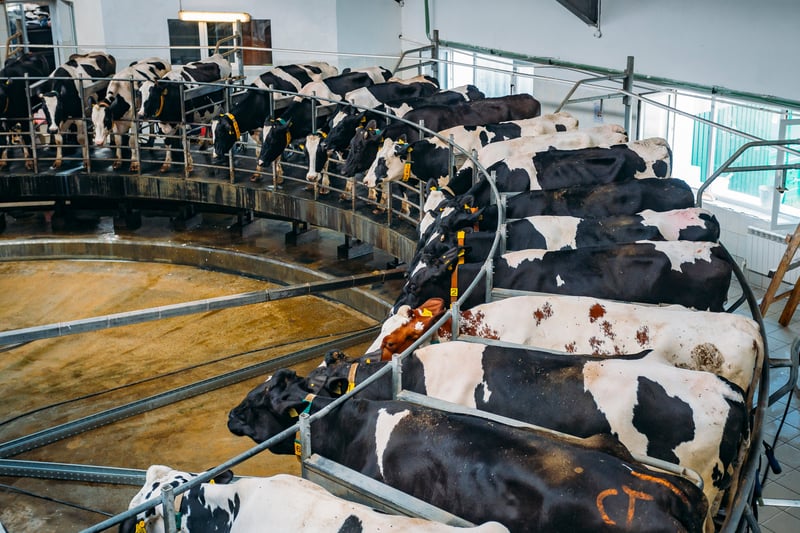
Bird flu didn't spread through farmed animals in 20 states by accident. Large-scale dairy operations keep huge numbers of cows in close quarters, move animals between facilities, and share equipment, workers, and milk. Those conditions are ideal for a virus to spread, and the industry has now admitted it has no way to stop it.
This is the pattern we see again and again in factory farming. Animals suffer, workers are exposed, and the public is asked to accept rising pandemic risk so that a small number of companies can keep producing at scale.
It doesn't have to be this way.
What Needs to Change
- Mandatory, transparent testing. Every state should require routine testing of dairy herds and publicly report results, so outbreaks are caught early instead of discovered after they've spread.
- Real protections for workers. Farmworkers need protective equipment, paid sick leave, access to testing, and health monitoring that isn't optional.
- A shift away from industrial animal agriculture. Public money should help farmers transition out of high-risk factory farming and into plant-based food production, rather than propping up a system that keeps producing new disease threats.
What You Can Do
Every time we choose plant-based foods, including plant-based alternatives to cows' milk, we reduce demand for the system that keeps fueling outbreaks like this one.