Unpredictable, Uncooperative, Entirely on Their Own Terms: How an Alaskan Trip Reignited My Fight for Animals
Blog
After 15 years of fighting for animals, I almost burned out. Then Alaska reminded me what this work is actually for.
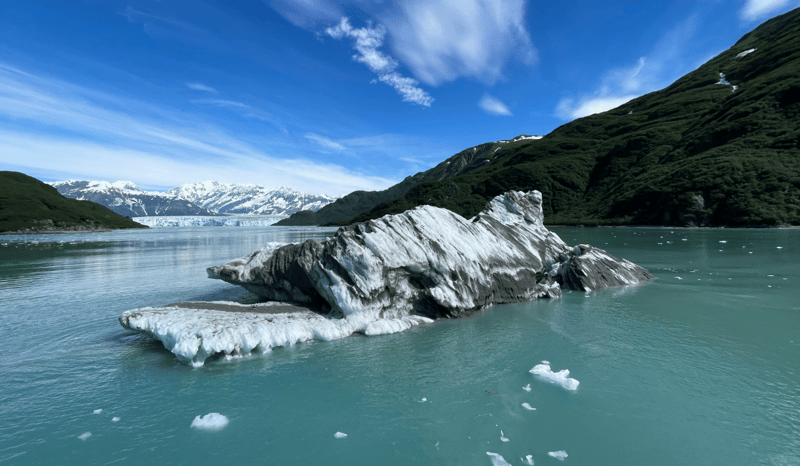
I had always wanted to travel to Alaska. I’d felt a pull there since I was a child, but even more so as an adult. When my sister said she was going, I jumped at the chance to tag along. It turned out to be one of the most impactful experiences of my life—not just because of what I saw, but because of what it taught me about conservation, about wildness, and about how disconnected we’ve become from the natural world.
This past July, I spent 13 days exploring the coastal towns of Alaska and Canada on an Azamara cruise. From Anchorage all the way down to Vancouver, my days were filled with excursions highlighting Alaska’s wildlife, conservation efforts, and Indigenous communities. And by the end of it, I came home with a completely reframed understanding of what it actually takes to protect wild animals—and how far removed most of us are from that understanding.
The Economics of Not Killing Whales
Alaska was once a major whaling community—not unlike Long Island, where I live, which has its own long and complicated whaling history. Species were hunted to the brink, but at some point, the math changed. Alaska’s economy shifted from extracting whales to protecting them, because a living whale, seen year after year by tourists willing to pay for the privilege, turned out to be worth more than a dead one. (Alaska’s National Park tourism contributed more than $2.3 billion and created 21,274 jobs in 2024, while the Alaska Travel Industry Association notes this “renewable resource” contributes billions more to the total economy annually.)
Our captain in Hoonah, near the Icy Strait, put it simply: the reason we could see these species in Alaska today is because the wildlife tourism industry directly funds the local efforts that preserve them—the boat operators who report illegal activity, the marine biologists tracking pod health (our tours had a student biologist on every one!), the protected waters that give orca and humpbacks room to actually be orca and humpbacks. Every excursion I went on, I watched captains slow their engines and reroute the second a fin appeared, even in the busiest port channel in the region. That’s not incidental good manners. That’s an entire industry that understands it thrives when the animals thrive.
It’s a model worth sitting with, especially for those of us who’ve spent years fighting for animals inside a nonprofit sector that is constantly scraping for resources. Alaska is proof that conservation doesn’t have to be a moral ask alone—it can be the actual business model, when a region chooses to build its economy around keeping animals alive and thriving in their own habitat rather than profiting from their capture or confinement.
Unpredictable, Uncooperative, Entirely on Their Own Terms
We tried, on our first excursion out of Port Valdez, to find orca—my favorite animal—and had no luck. We saw sea lions sleeping out on buoys, puffins diving alongside the boat, otters asleep in a “raft,” and humpbacks surfacing in the distance. But no orca. I was disappointed, and then I caught myself being disappointed, because the reason we didn’t see them is that they had an entire ocean to be in. They weren’t obligated to show up for us.
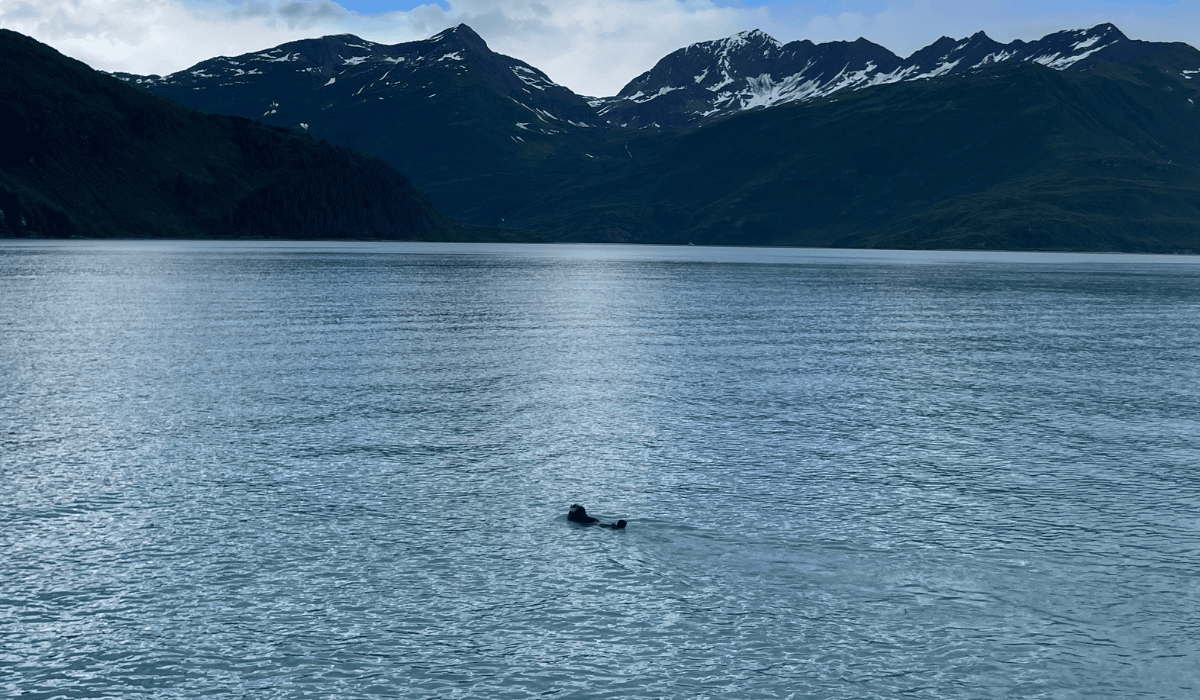
An otter floating along.
A week later, near Icy Strait Point, a pod of transient orca did show up—splitting off through the channel, presumably going to hunt seals along the shoreline, moving with total autonomy. Days after that, off the ship’s balcony, a pod of at least seven adults and a calf surfaced right beside us, unannounced, on their own schedule, going wherever the orca wanted to go.
I’ve spent over 15 years fighting against the confinement of animals like these—species built to travel dozens of miles a day, kept instead in tanks a few hundred feet across for our entertainment. Seeing orca in the wild made the contrast impossible to unsee. An orca at a marine park like SeaWorld is a false representation of who that orca truly is. What I watched in Alaska—unpredictable, uncooperative, entirely on their own terms—was the whole animal. No amount of trained behaviors or glass-walled proximity replicates that. It isn’t a “better version” of the same experience; it’s a fundamentally different thing, and the only one that is fair to the animal.
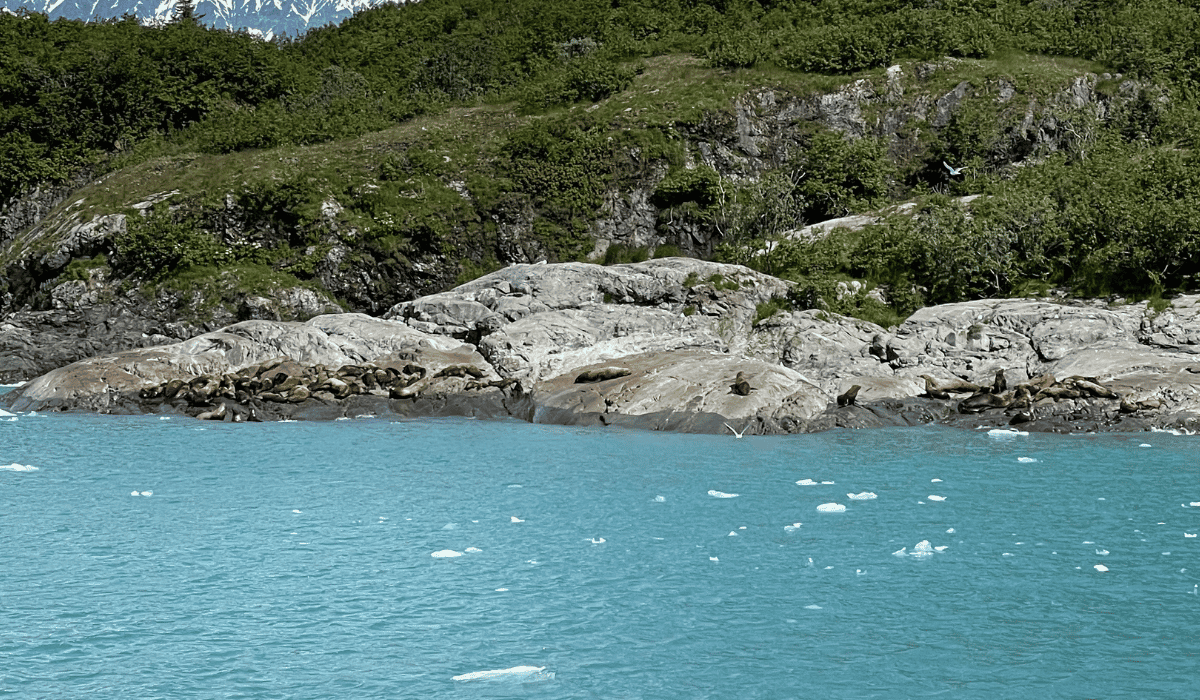
A colony of sea lions.
A Culture That Never Forgot It is Part of Nature
What struck me just as much as the wildlife was how present Indigenous cultures are throughout Alaska, and how differently many cultures relate to the land and animals around it. Watching the wind move through the Tongass National Forest, or hearing a blowhole echo across the water at dusk, I felt I understood a little more about why many Indigenous communities built entire belief systems around the spirits of wind, water, salmon, orca, and eagle: because when you live in that kind of proximity to the wild, the idea that humans are separate from nature simply doesn’t hold up.
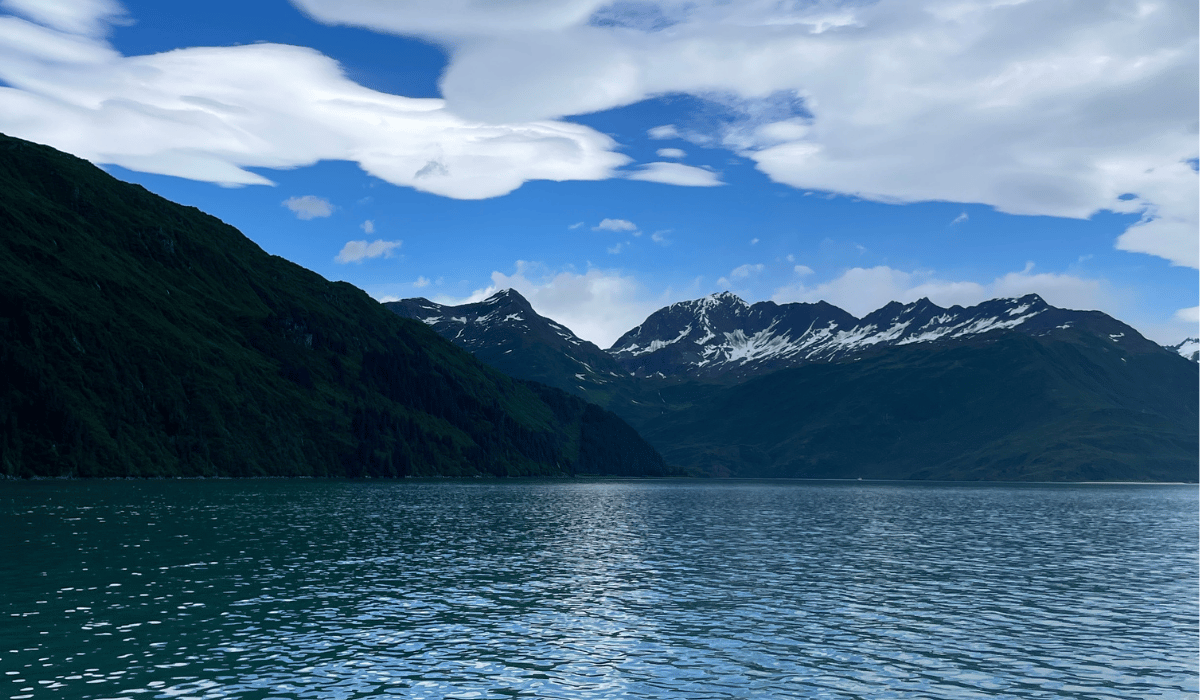
Tongass National Forest.
In Ketchikan, the Salmon Capital of the World, residents built a salmon ladder to give fish a gentler route upstream to spawn—a small, deliberate act of coexistence, not dominance. It’s a far cry from how many communities in the rest of the country treat “nature” today, as something to visit on vacation and otherwise keep at arm’s length.
That’s the disconnect I think a lot of us in the animal protection movement are actually fighting. Not just challenging cruelty in the abstract, but exposing a deeper cultural belief that humans exist outside of and above the natural world, rather than within it, dependent on it, and responsible to it. Alaska—and the Indigenous communities who have called it home far longer than any cruise line—offered me a glimpse of what it looks like to actually live inside that understanding instead of just visiting it.
Formalizing the Model: Wildlife Heritage Areas
What I watched happen in Alaska—an entire regional economy organizing itself around keeping wild animals wild—is exactly what World Animal Protection has been working to formalize elsewhere in the world. Through our Wildlife Heritage Areas program, developed in partnership with the World Cetacean Alliance, World Animal Protection designates places where a local community has built a genuine, respectful relationship with a wild species or habitat, and where that relationship is actively managed to put the animals’ needs ahead of commercial interests. It grew out of the Whale Heritage Sites program, which got its start recognizing communities in Australia and South Africa for responsible whale and dolphin watching, and has since expanded to cover wildlife on land as well as at sea.
The criteria aren’t just about proximity to animals—they’re about whether a community has built ongoing research, education, and coexistence into how it manages that relationship, and whether the animals’ well-being is what’s actually being protected, not just marketed. Places like the Santa Barbara Channel in California and Tapir Valley in Bijagua, Costa Rica, a current Wildlife Heritage Area candidate, earned that recognition for exactly the kind of work I saw happening informally in Icy Strait Point and Ketchikan.
Alaska doesn’t have an area on the list yet—though after this trip, I’d argue it has a strong case, and I hope it gets there. In the meantime, the growing list of designated Wildlife Heritage Areas around the world is worth knowing about and worth supporting, whether that means planning a trip around one or simply backing the organizations working to expand the list. While many wild animal attractions—like SeaWorld—make claims of supporting conservation that are downright greenwashing, every one of these places is proof that aligning tourism and conservation goals is possible. Done right, tourism is conservation.
I came home from those 13 days with my fighting spirit back. Not because the fight got any easier, but because I got to see, up close, what it looks like when an entire place organizes itself around the idea that wild animals are worth more alive, free, and undisturbed than they are any other way. That’s not a fantasy. Alaska is living proof it’s possible.