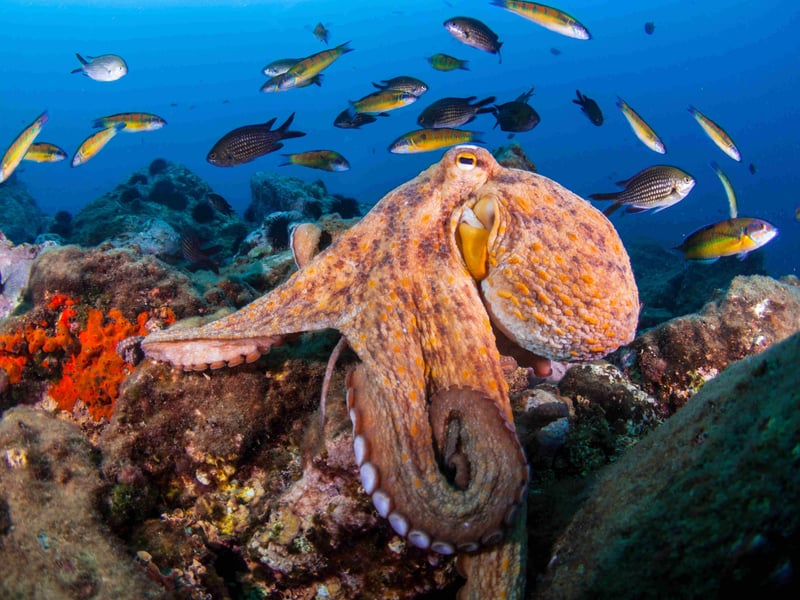
After years of advocacy, plans for the world’s first commercial octopus farm have been scrapped.
Plans for the world’s first commercial octopus farm have been abandoned—a major win for animal protection after years of sustained pressure from advocacy groups, scientists, and the public.
Spanish seafood multinational Nueva Pescanova had been pursuing plans since 2019 to build a large-scale octopus farm at the port of Las Palmas in Gran Canaria, aiming to produce thousands of pounds of octopus meat a year. The proposal drew fierce opposition from the start, as advocates warned that farming octopuses at an industrial scale would cause severe suffering to an animal now widely recognized as intelligent and sentient.
How Collective Pressure Helped Stop the Octopus Farm
Working alongside allied organizations, World Animal Protection helped raise awareness of the risks of octopus farming, mobilizing the public to speak out against a project that would have caused significant suffering to octopuses. Groups including Compassion in World Farming led campaigns against the plans, publishing research on the welfare and environmental risks and gathering support from expert nonprofits, elected officials, and scientific experts.
That five-year campaign of public pressure and legal challenges coincided with a formal environmental review that ultimately sank the €65 million (over 75 million USD) project: regulators found the facility risked fouling air quality near a passenger terminal and degrading the port’s water with organic waste. Nueva Pescanova has characterized its decision to abandon the roughly 1,000-tank facility as based on “business and regulatory” factors alone, without conceding welfare or ethical concerns—but the outcome is the same either way: a plan to farm and slaughter an estimated one million octopuses a year will not move forward.
“Factory farming of octopus would have been cruel and unsustainable. We know that octopuses are highly intelligent animals capable of problem-solving, learning, and experiencing pain. They are solitary animals and become aggressive when surrounded by others, so they would especially suffer in farming conditions. Octopuses also need to be fed other marine creatures, creating a loop of potential animal suffering and loss of ocean biodiversity—similar to the factory farming of pigs and chickens. Factory farming of octopus should never have been on the agenda, and it's time we phased out factory farming of all animals for good.” — David Garrahy, External Affairs Manager, World Animal Protection
Why Octopus Farming Raised Such Serious Welfare Concerns
Octopuses are solitary by nature and thrive on complex environments to explore—they would have suffered significantly in the crowded tanks proposed for the Gran Canaria farm, which were designed to hold up to 1,000 animals apiece. They are highly intelligent, sentient animals that have been documented struggling in captivity to the point of cannibalism and self-harm. Scientists also raised alarm over the proposed slaughter method—plunging octopuses into sub-freezing ice water—which researchers have called inhumane. The farm’s environmental footprint raised additional concerns, including its reliance on wild-caught fish for feed and its potential impact on marine biodiversity near the site.
New York Can Cement This Progress
The Spanish farm’s collapse follows growing recognition in the US that industrial octopus farming has no place in a humane food system—California and Washington have already banned the practice outright.
This global victory is a reminder of what sustained pressure can accomplish—and New York State has the chance to make sure a commercial octopus farm never opens on our shores, either. World Animal Protection US is proud to be working alongside Voters For Animal Rights (VFAR) and Woodstock Farm Sanctuary and numerous nonprofits to pass (S.7421B/A.8043C), which would ban industrial octopus farming in the state.
The bill has already cleared both chambers of the New York State Legislature with strong bipartisan support—passing the Senate 55-5 and the Assembly 129-13. It now needs only Governor Hochul's signature to become law.
Take Action: Ask Governor Hochul to Prohibit Industrial Octopus Farming
Octopuses are intelligent, sentient animals who don’t belong in industrial farms—not in Spain, not in New York, not anywhere. Governor Hochul can make sure New York never becomes home to this cruel industry, but she needs to hear from us first.
New Yorkers ONLY: Contact Governor Hochul using her official web form and ask her to prohibit industrial octopus farming in New York State.
Not in New York? Take action to support the federal OCTOPUS Act here.
Millions of animals still suffer in industrial farms on land and at sea. We’ll keep fighting for higher animal protection standards and working toward a food system that’s more humane, ethical, and sustainable—for animals, people, and the planet.