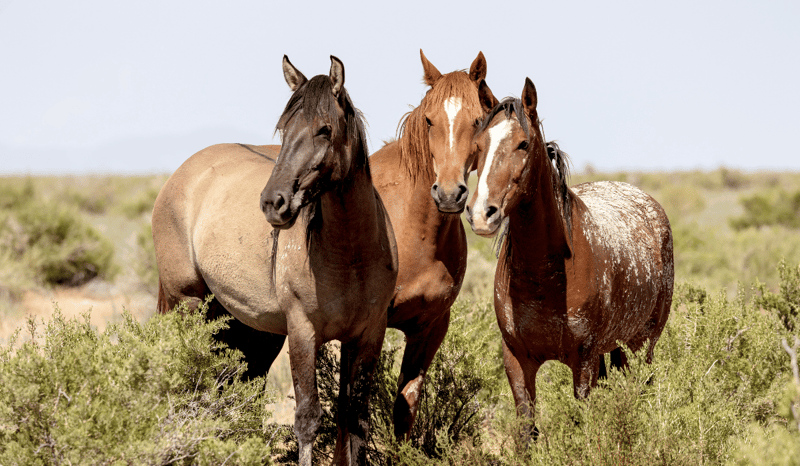
Wild horse roundups are sweeping the American West, and many horses are ending up in slaughterhouses.
Thousands of wild horses and burros are currently being chased down by helicopter, penned, and hauled off public land across the American West. The Bureau of Land Management (BLM) is in the middle of a packed roundup season, with operations already completed or underway in western Colorado, southwestern Utah, Nevada, southwestern Idaho, California, and Wyoming. More are scheduled through the fall, including a removal of roughly 360 horses from Utah’s Confusion Herd Management Area and about 286 horses from Wyoming’s Fifteenmile Herd Management Area in September.
The BLM says these removals are necessary to keep herd sizes within what the land can sustainably support. But the roundups themselves are traumatic: helicopters drive horses for miles across rough terrain, family bands are broken apart, and animals who don’t die or get injured in the chase are trucked to holding facilities, where more than 60,000 wild horses and burros are already confined—many with no path back to the range and no real prospect of adoption or rehoming in sanctuaries.
From Public Land to the Slaughter Pipeline
Federal law makes it illegal to sell or send wild horses and burros to slaughter. In practice, that protection has gaps.
Horses who go unadopted after multiple attempts, along with those over age 10, become eligible for sale rather than adoption. The moment a horse is sold instead of adopted, they lose their federal protections under the Wild Free-Roaming Horses and Burros Act of 1971. Buyers sign agreements promising not to slaughter the animals or resell them to anyone who will—but a recent New York Times investigation found that horses have moved through intermediaries not bound by those agreements, later turning up at livestock auctions and on trucks bound for Canadian and Mexican slaughter plants.
The BLM disputes that it sends horses to slaughter and says it remains committed to finding good homes for these animals, but as the agency has sharply increased sales of horses it classifies as “unadoptable,” the paper trail connecting federal custody to foreign kill floors has grown harder to ignore.
A Budget Proposal That Could Make Things Worse
The politics around wild horse management are shifting, too. The Department of the Interior’s Fiscal Year 2027 budget proposal would cut funding for the BLM’s Wild Horse and Burro Program from nearly $142 million to about $106.8 million. That reduction is concerning on its own, but advocates have flagged that the proposal drops long-standing congressional language that has historically barred the government from killing healthy wild horses and burros outright or selling them for slaughter.
If Congress doesn’t restore that language during the appropriations process, one of the few remaining legal backstops against slaughter could disappear!
Congress Can Choose a Better Way
None of this is inevitable. Fertility control, non-lethal gathers used sparingly, and keeping family bands intact in the wild all reduce herd growth without the trauma of mass removal and warehousing. What's missing isn’t a solution—it’s the political will to fund and prioritize that solution over large-scale roundups and sales.
That’s exactly what the federal Save America’s Forgotten Equines (SAFE) Act would help fix, and it has bipartisan support. The SAFE Act would permanently ban horse slaughter for human consumption in the United States and close the export pipeline that sends American horses—wild and domestic alike—to slaughterhouses in Canada and Mexico. It’s the clearest, most durable way to make sure no horse who passes through federal custody ends up on a kill floor, regardless of what happens in any single year's budget fight.
Take Action: Call Your Member of Congress
Wild horses can’t lobby Congress, but we can.
Call your US Representative and Senators today and urge them to support the SAFE Act. A phone call takes two minutes and carries real weight—congressional offices track every call and use that count to gauge whether an issue matters to constituents.
Here’s what to say when you call:
- Tell the staffer you’re a constituent calling about the SAFE Act.
- Ask your Representative or Senator to cosponsor and support the SAFE Act to permanently end horse slaughter and the export of horses for slaughter.
- Mention that you’re calling because of ongoing wild horse roundups and reporting that federally protected horses have ended up in the slaughter pipeline.
- Thank them for their time.
You can find your representatives’ phone numbers at house.gov/representatives/find-your-representative and senate.gov/senators/senators-contact.htm.