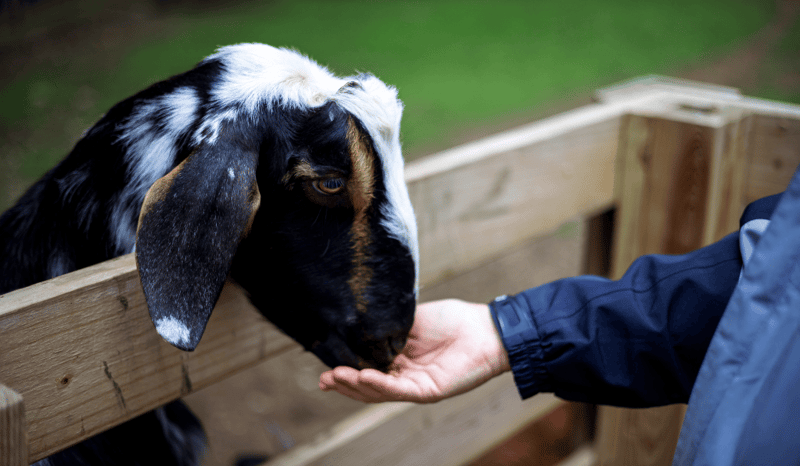
When we exploit animals, we put ourselves and our families at risk, too.
Farm Adventures, a traveling petting zoo based in Harmony, North Carolina, spent this summer hauling baby goats to at least 10 off-site events—a back-to-school bash, an assisted living facility, and several private parties. According to The New York Times, the goats were most likely exposed to rabies after a skunk got into their pen. Three tested positive, a fourth was presumed infected, and all four were euthanized. Now every family who touched those goats has to find out whether they need treatment for a disease that’s almost always fatal once symptoms start.
This is the predictable result of a business model built around forcing close human contact onto animals for profit—and it’s a small, sharp example of a much larger pattern: when we exploit animals, we put ourselves in harm’s way too.
A Model Built for Spillover
Mobile petting zoos move young, handling-tolerant animals from site to site to be touched by as many people as possible. That’s also exactly the setup that lets diseases move—animals exposed to wildlife on the road, exposed to hundreds of unscreened hands at each stop, with no way to monitor every animal for a disease that can incubate silently for weeks. The goats paid first, with their lives (confirmation of rabies is done by testing the animal’s brain after death). The families are paying second, with the anxiety and cost of exposure treatment.
The Same Pattern at Scale
Wild animals as pets: Reptiles are a well-known source of Salmonella in children—a rare strain traced to the bearded dragon trade sickened infants across the US and Canada in 2021–2022. Pet prairie dogs caused the first US monkeypox outbreak. None of this is the animals’ fault; it’s the human decision to breed, sell, and handle a wild species. Most emerging infectious diseases in humans are zoonotic, and most of those originate in wildlife.
Fur farming: Packing animals into close, high-density confinement is exactly how spillover happens. We watched it happen on fur farms: Denmark culled over 14 million mink in 2020 after the COVID-19 virus mutated inside them, and outbreaks hit farms in the Netherlands, Spain, and the US.
That risk is still compounding. USDA’s tracker of highly pathogenic avian influenza (HPAI) detections in mammals confirmed H5N1 on a Utah mink farm in August 2026—the first such US detection of H5N1 on a mink fur farm.
Protecting People and Animals
A goat at a birthday party, a bearded dragon in a kid’s bedroom, a mink in a wire cage—these are the same equation at different scales. The closer and more forced the contact we create with animals, the more openings we hand viruses to move from them to us. Protecting people and protecting animals from exploitation aren’t competing goals. They’re the same goal.
Donate to World Animal Protection today so we can keep fighting for animals everywhere they need us.