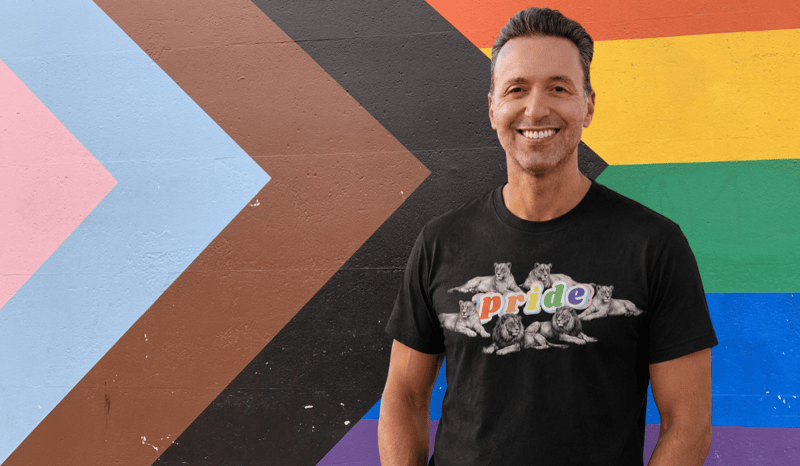
Being an advocate and an ally isn’t about drawing lines around who is worthy of compassion. It’s about questioning those lines altogether.
I’m gay. I’m also an animal advocate—and yes, I’m a vegan, too.
To a lot of people, those things may seem unrelated. To me, they’re deeply connected.
Growing up, I was bullied in school because of who I was. I didn’t yet have the language for it, but somehow everyone else seemed to know I was different. I still remember the dread of walking down the hallway to assembly every Friday, the knot in my stomach as the older kids zeroed in on me. The insults, the laughter, the feeling of being exposed. I never told anyone—not my parents, not my teachers. I was too ashamed. And because I stayed silent, no one ever stepped in. No one even knew to.
That experience doesn’t leave you. It shapes how you see the world. It teaches you, early on, what it feels like to be targeted and powerless.
Years later, my life looked very different. I was out, married, and building a life I was proud of. I cared deeply about equality and justice. I showed up for my community. But, if I’m being honest, my definition of “justice” had limits. It mostly stopped at humans.
Then something shifted.
One morning, I was watching The View when Alicia Silverstone appeared as a guest. She casually mentioned she was vegan, and when asked why, she said something simple: “I love my animals. I love my dog. And one day I looked at him and thought, why don’t I eat him?”
That stuck with me. I loved animals too. I would never consider eating my cats, so why was I eating other animals? That question sent me down a rabbit hole.
After the show concluded, I went to my laptop and searched Alicia Silverstone and veganism. What I found changed my life. I watched footage from inside factory farms and slaughterhouses—scenes that, frankly, I wasn’t prepared for. Animals trembling with terror, confined, beaten, treated as if their suffering and their lives meant nothing. And what struck me most wasn’t just the cruelty, it was the familiarity of the feeling. That fear. That helplessness. That sense of being completely at the mercy of someone more powerful.
I recognized it.
Not in the same way, not on the same scale, but enough to understand. Enough to feel it in my gut. And I knew it was wrong.
That was the moment everything clicked for me. Being an advocate and an ally isn’t about drawing lines around who is worthy of compassion. It’s about questioning those lines altogether. It’s about asking: if I know what it feels like to be bullied, to be tormented—how can I ignore that experience when it’s happening to someone else, even if that “someone” isn’t human?
Going vegan became part of that journey, but it wasn’t the beginning or the end. It was one expression of a broader commitment: to live in alignment with the belief that suffering matters, no matter who experiences it, that my kindness should extend to all.
To me, the connection is simple. When you’ve been on the receiving end of cruelty or exclusion, you have a choice. You can compartmentalize it, or you can let it expand your empathy.
I chose the latter.