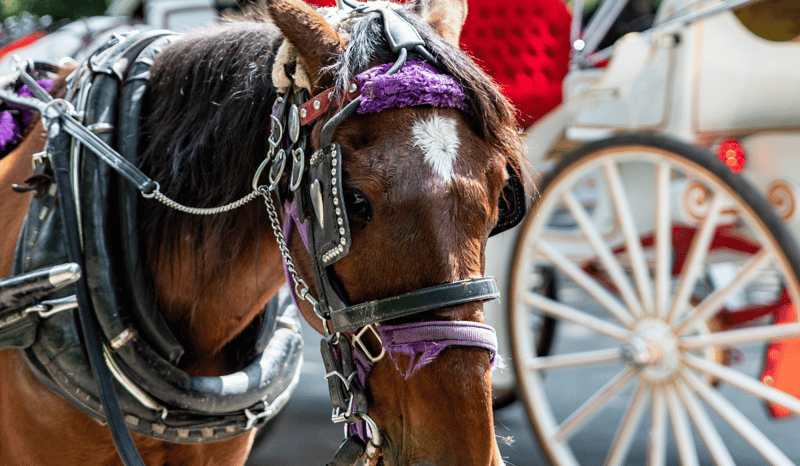
In October 2026, New York City Council finally decided to pass the ban on horse carriages.
On October 22, the New York City Council voted 40 to 7 to ban horse-drawn carriages, a veto-proof majority that marks the beginning of the end for an industry that has operated in the city since 1858.
For more than 160 years, horses have been made to haul tourists through some of the most crowded, loud, and chaotic streets on Earth. Now, finally, there's an end date.
What the Law Does
Romanch's Law (Intro 943), sponsored by Council Member Christopher Marte and championed by Speaker Julie Menin and the City Council, stops the city from issuing new carriage licenses and ends all horse-drawn carriage operations on June 1, 2028.
Just as important, it protects the horses on the way out. The law prohibits selling or transferring the horses for slaughter or transferring them to other carriage companies, so the animals who leave Central Park don't simply end up suffering somewhere else. It also requires the city to develop a transition plan for carriage drivers by April 1, 2027.
The bill now heads to Mayor Zohran Mamdani, whose office has said plainly that he will sign it.
A Name No One Should Have to Give It
The law carries the name of Romanch Mahajan, an 18-year-old visitor who was killed on June 17 when a carriage horse bolted in Central Park during a family trip. His death is a tragedy, and it should never have happened.
But it was not a freak accident. It was the predictable outcome of a system that has been failing horses and people for years. In August 2022, a carriage horse named Ryder collapsed in the middle of a Hell's Kitchen intersection and died that October. In 2025, another carriage horse named Lady collapsed and died on a Manhattan street. Each time, the city promised more oversight. Each time, the horses went back into traffic.
Why This Was Always Inhumane
World Animal Protection's position is simple: using horses to pull carriages through city streets is inhumane. There is no version of this industry that works for horses.
Horses are prey animals. They are wired to flee from sudden noise and movement. Put them between the shafts of a carriage in Midtown, and you are asking them to stay calm amid sirens, car horns, buses, construction and crowds, for hours at a time, every day. When a horse does what horses are built to do and bolts, there's a heavy carriage behind them and people in their path.
Then there's everything else: hard pavement under their hooves, heat radiating off the asphalt in summer, exhaust fumes at nose level, long shifts and stalls far from any pasture. Horses need room to move, graze, and be with other horses. A city street offers none of that.
Regulations can adjust hours or temperature cutoffs. They can't change the street. That's why ending the industry, rather than tinkering with it, is the only humane answer.
This Win Belongs to Decades of Activists
This ban didn't come together in one news cycle. It's the result of nearly 20 years of work by lawmakers and advocates who kept going long after it would have been easier to quit.
In December 2007, Queens Council Member Tony Avella proposed the first outright ban on the industry. City Hall opposed it, and the bill stalled. Council Member Avella didn't let it go. After moving to the State Senate, he took the fight to Albany with a bill to ban carriages in New York City, and Assembly Member Linda Rosenthal carried the companion bill in the Assembly.
Assembly Member Rosenthal reintroduced that bill session after session for more than a decade, and neither the bill nor the issue ever disappeared, even when the politics looked hopeless.
After Ryder collapsed in 2022, Council Member Robert Holden picked up the fight with Ryder's Law. When a Council committee voted it down in late 2025, its supporters vowed to bring it back. This year, they did. Council Member Christopher Marte carried the bill, and Health Committee Chair Lynn Schulman signed on as a co-sponsor and chaired the July hearing, where New Yorkers testified for nearly ten hours.
The Council's new Animal Welfare Caucus helped make the difference. Co-created by Speaker Menin in March and chaired by Council Member Harvey Epstein, one of the bill's prime sponsors, the 21-member bipartisan caucus gave animals an organized bloc inside City Hall. In the end, Speaker Menin brought the bill to the floor, 40 Council Members voted yes, and Mayor Mamdani committed to signing it.
This win also belongs to Romanch's family, whose unimaginable loss changed the course of this debate. They lobbied at City Hall, gave testimony at the hearings, and were present at the vote in October. And it also belongs to the countless New Yorkers who testified at hearings, rallied outside City Hall, called their Council Members and refused to look away through nearly two decades of failed bills, broken promises and horses who didn't make it home.
They did the hard work. We're grateful, and we're glad to celebrate alongside them.
What Comes Next
The fight isn't quite over. The carriage drivers' union has vowed to challenge the law in court, and the next 19 months matter enormously. Every horse currently working in the industry deserves a permanent, safe home where they can finally rest, and the city must hold firm on the protections this law promises. A fair transition for workers is part of doing this right, too.
And the message reaches far beyond New York. When one of the most visited cities in the world decides that horses don't belong in traffic, cities everywhere still running carriage rides should be paying attention. Tradition is not a reason to keep animals in harm's way.
Want to keep updated on how you can help animals in New York? Sign up for our email newsletter today.