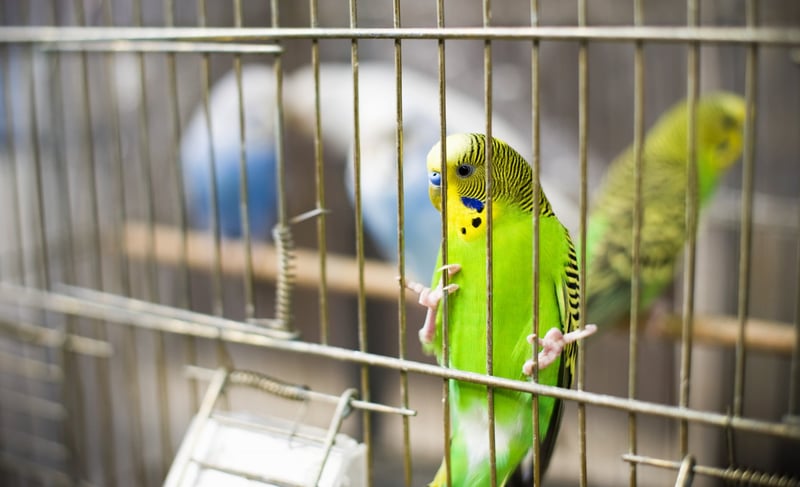
Council Member Harvey Epstein’s Intro 912 would shut down the bird mill pipeline, and New York’s birds need us to fight for it.
Most people who buy a bird at a pet store don’t know where they came from. They see a colorful parrot in a clean cage, maybe a price tag, maybe a little pamphlet about diet and care. What they don’t see is the mill the bird came from.
New York City Council Member Harvey Epstein has reintroduced Intro 912 (formerly Intro 1325), legislation that would ban the sale of birds in NYC pet stores. The bill builds on years of work, including legislation first introduced in 2025 by Deputy Speaker Diana Ayala. World Animal Protection has been fighting alongside Voters For Animal Rights and the Avian Welfare Coalition to make this a reality, and we’re not done yet. We need your help to get it over the finish line.
Meet Mei Mei: a New York City Bird With a Second Chance
For ten weeks, a little parakeet named Mei Mei was spotted flying through Central Park, alone and exposed. She survived by joining a flock of sparrows, but she was in serious danger—vulnerable to predators, to the cold, to everything a domestically-raised bird is completely unprepared for. Rescuers JP and Sean spent weeks tracking her through Central and Morningside Parks before finally catching her with the help of fellow birders and park-goers.
We don’t know whether Mei Mei was abandoned or escaped, but we do know she was almost certainly born in a bird mill—trapped in a small, dirty cage with thousands of other parrots, then shipped to a pet store, and then likely sold to someone who, for whatever reason, could no longer keep her.
Mei Mei is now safe and loved at Foster Parrots, one of the country’s top avian sanctuaries. For the first time in her life, she can flock with other parrots, forage, and just be a bird. She is one of the lucky ones. Most aren’t.
Where Pet Store Birds Actually Come From
Most birds sold in pet stores come from mills, massive commercial breeding operations that are, in every meaningful sense, factory farms for parrots and songbirds. Inside these facilities, hundreds or thousands of birds are crammed into small cages. They can’t fly. They can’t socialize. They can’t raise their own babies.
In January, World Animal Protection US released the first undercover investigation into bird mills, revealing conditions that are genuinely heartbreaking: barns so hot that birds died from the heat, cages encrusted with waste and moldy food, dead rats decomposing inside enclosures alongside living birds. One mill owner later admitted to inspectors that he kills birds with car exhaust. This is what the pet store pipeline looks like at its source.
Parrots Aren’t Low-Maintenance Pets. They’re Flock Animals.
The vast majority of birds sold in pet stores are parrots, some of the most intelligent, emotionally complex animals on the planet. In the wild, parrots live in large, tight-knit flocks. They form deep bonds. They communicate constantly. They are not designed for solitary life in a cage.
Many people bring a parrot home without realizing any of this, and what follows is often heartbreaking. Deprived of their families and any semblance of freedom, birds develop serious psychological problems. They pluck out their own feathers. They scream for hours. They become aggressive, not because they are “bad” birds, but because they are suffering.
Shelters and Rescues Are Overwhelmed. This Would Help.
Mei Mei’s story is not unusual. Birds like her end up in Central Park, in shelters, in sanctuaries, or they don’t end up anywhere safe at all.
When the reality of bird ownership turns out to be nothing like what the pet store suggested, many people surrender their birds to sanctuaries, rescues, and shelters. Organizations that are already full and in crisis, who are already turning birds away.
Others simply (illegally) release their birds into the wild, a death sentence for most of them. Starvation, exposure, predation. There is no good outcome for a domestically-raised bird released onto a New York City street.
Rescues and sanctuaries cannot keep pace with the volume of birds the pet industry produces. Intro 912 would address this problem at the source, not the symptom.
It’s All Hands on Deck. Here’s How You Can Help Right Now.
If you live in NYC, contact your council member and tell them to support Intro 912. It takes two minutes and it matters.
If you’re outside NYC, sign our petition to ban the sale of birds in pet stores and show that this issue has national support.