Trump’s BLM is evicting bison from Montana federal lands to make way for cows. Learn how factory farming displaces wildlife globally—and what you can do.
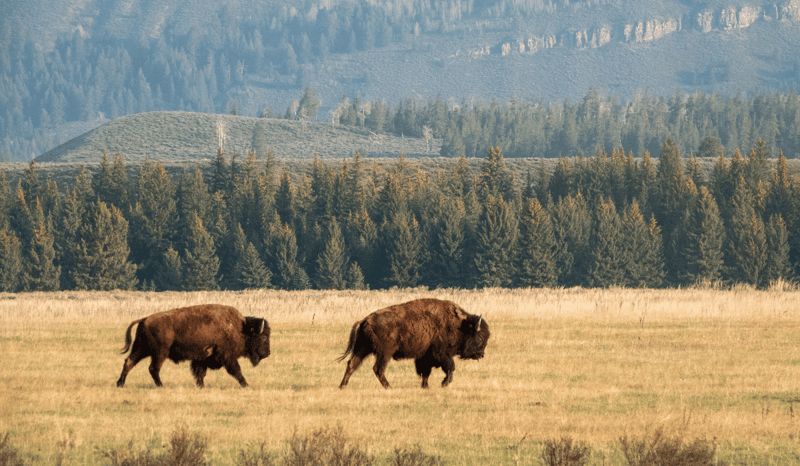
The American bison is the official mammal of the United States. The bison’s image sits on the seal of the Department of the Interior. Bison survived near-extinction—hunted from an estimated 30 to 100 million animals down to fewer than 1,000 by 1890—and clawed their way back to a population of about 500,000. That recovery took over a century of conservation work, legal protection, and cooperation between federal agencies, nonprofits, and Indigenous nations.
Now the Trump administration wants to undo part of that.
Bison Evicted. Cows Welcome.
The Daily Beast reports that the Bureau of Land Management (BLM)—a division of the Department of the Interior—has moved to revoke American Prairie’s license to graze bison on federal lands in Phillips County, Montana. The justification? The BLM cited the Taylor Grazing Act of 1934, arguing the land must be used to raise farmed animals for food—and that the roughly 950 bison on those lands count as “wildlife,” not farmed animals. Because the nonprofit has been working to primarily conserve the species and increase the number of individuals in the herd, not farm them for their meat, milk, or other bison “products,” the BLM has revoked the permit to allow bison to graze, and now cows will mosey in to take their place.
This is breathtaking in its cynicism. Interior Secretary Doug Burgum’s proposed ruling argues the bison aren’t being raised for “production-oriented purposes”—a phrase that doesn't appear anywhere in the Taylor Grazing Act itself.
American Prairie CEO Alison Fox told USA Today:
“This proposal is an unprecedented reversal of BLM’s own decision-making after more than 40 years of treating bison as eligible livestock under federal grazing law. BLM lawfully approved these permits after a thorough environmental review and defended them for years. Abruptly rescinding them now—under political pressure—creates immense uncertainty and sends a chilling signal to Tribes, ranchers, and conservation partners who depend on fair and predictable public land management.”
There’s an additional ethical dimension worth noting: Associate Deputy Secretary of the Interior, Karen Budd-Falen, was previously a private attorney representing ranchers who sued to block American Prairie’s permits. She originally recused herself from grazing matters, but received an ethics waiver in March 2026, allowing her to shape the very policy her former clients wanted.
So, who benefits from BLM’s decision? Ranchers, who will access grazing leases at fees roughly 90 percent cheaper than rates on privately owned land in Montana. And the losers? Bison, of course. And, the tribal nations who have helped to conserve and protect them.
The Coalition of Large Tribes, representing over 50 Indigenous tribes, warned the plan could have “unintended negative consequences for tribal bison herds.” For Indigenous peoples whose cultures, food systems, and spiritual practices are interwoven with the bison, this is more than an environmental setback. It’s a continuation of erasure.
This Pattern Has a Name
What’s happening in Montana is not an isolated political squabble. It is one instance of a pattern playing out across the globe: wild animals being pushed off the land where they belong so that meat and dairy production can take over.
We see it in the numbers. Farmed animal grazing now occupies 30 percent of the Earth’s total land area. Animal farming systems use about 77 percent of all agricultural land while providing less than 20 percent of the global calorie supply. The UN’s 2019 Global Assessment Report on Biodiversity and Ecosystem Services found that industrial agriculture is the primary driver of biodiversity collapse. A study published in Nature Sustainability projected that nearly 88 percent of the world’s mammal, bird, and amphibian species will lose habitat to agricultural expansion by 2050, with nearly 1,300 species losing at least a quarter of their remaining habitat. The IPBES assessment found that more than a third of the Earth’s land surface is now devoted to crop or livestock production.
Every bison evicted from a Montana prairie is a symptom of this larger systemic problem.
The Amazon: Where This Story Gets Deadly
Nowhere is the link between industrial meat production and wildlife displacement more violent than in the Amazon rainforest, and nowhere is the role of a single corporation more stark.
JBS, the world’s largest meat company, has been at the center of Amazon destruction for decades. In October 2024, Brazil’s environmental agency IBAMA levied fines totaling 365 million reals (approximately $64 million USD) on ranches and meatpacking companies, including JBS, for involvement in illegal Amazon deforestation. Despite pledging to eliminate all deforestation from its Brazilian Amazon supply chain by 2025, investigations show JBS continued buying cows from embargoed, deforested farms.
The Amazon is not simply a forest. The rainforest shelters half of all animal, plant, and insect species known to humanity. Jaguars. Maned wolves. South American tapirs. Hundreds of bird species. Thousands of insect species. Our own research has documented how industrial meat production and JBS’s clearing of land for ranching displaces over 10,000 species in the Amazon alone.
The deforestation is not random. Research shows that the greatest deforestation occurs near slaughterhouses and roads with access to them. Build a feedlot; lose a forest. Lose a forest; lose the animals that live there. The logic is brutal and simple.
The Same Story, Different Latitudes
The bison of Montana and the jaguar of the Amazon may seem worlds apart, but they are protagonists in the same story: the story of wild animals being systematically displaced from their homes to make way for industrial meat production.
In Montana, the displacement is dressed in legal language: permit revocations, grazing acts, and “livestock” definitions. In the Amazon, it arrives with chainsaws and fire. The methods differ. The outcome is the same: animals lose, meat industry wins.
As we’ve documented in our wildlife habitat loss research, “animals affected by habitat loss are displaced from their homes, unable to find food and water.” That’s a clinical description of something that is, in practice, a death sentence for individuals and for the species.
We cannot continue treating wildlife as an obstacle to profit. The bison of Phillips County, Montana, are doing exactly what they are supposed to do: restoring a grassland ecosystem, contributing to biodiversity, and reminding us that land is a precious resource. The Trump administration’s move to evict them is not progress. It is repetition—the same mistake, made again, at the expense of animals who have no vote and no lobby.
World Animal Protection will continue to fight for wild animals’ right to their wild homes—in Montana, in the Amazon, and everywhere else this story is being written, but we can’t do it without you.
Donate today to help animals wherever they need us most. Whether it’s bison being pushed off their prairies, jaguars losing their rainforest, or the millions of wild animals displaced every year in the name of industrial meat production—your support powers our fight to protect them all.